
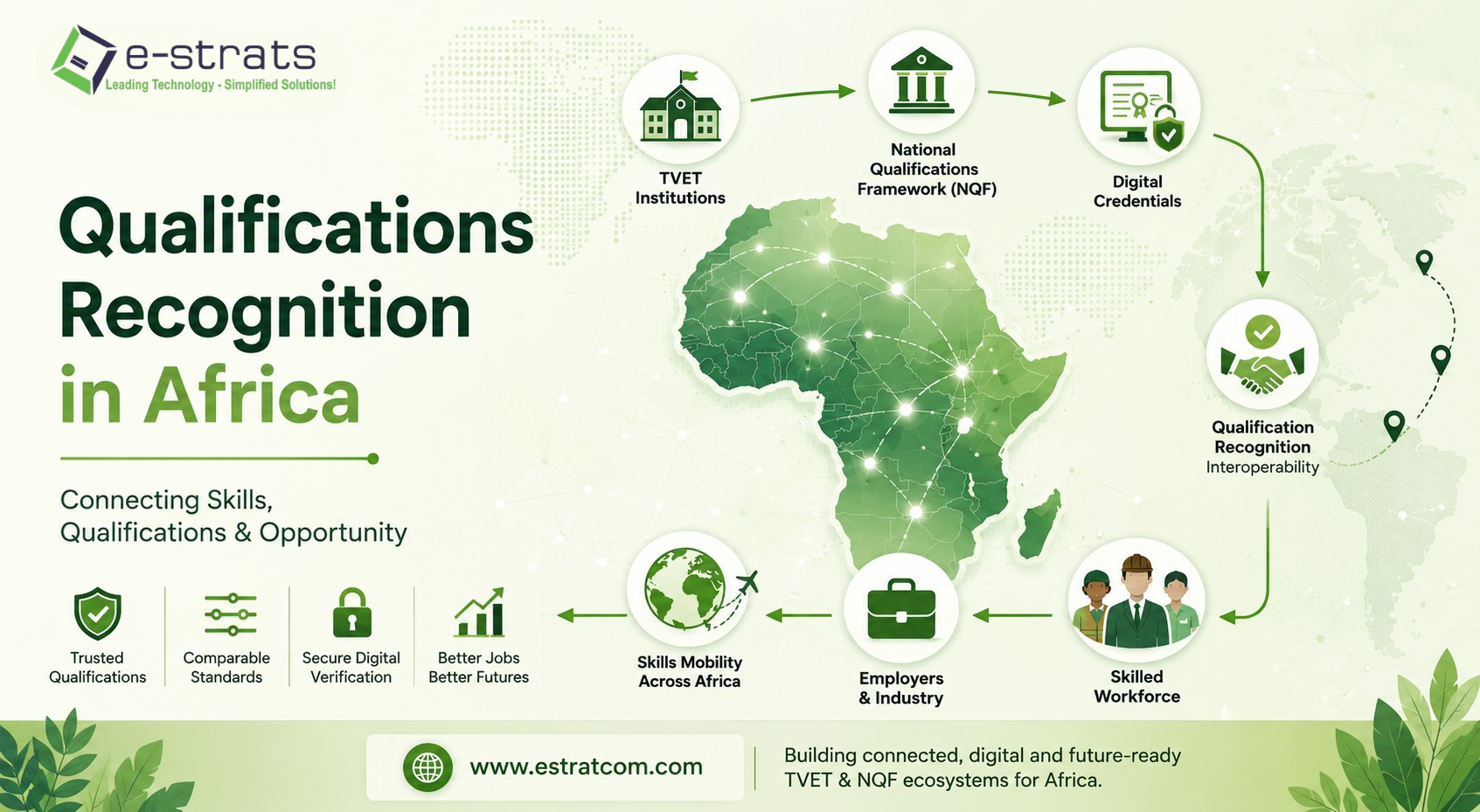
Africa’s workforce is entering a period of profound change, making Qualifications Recognition in Africa increasingly important for building a skilled, mobile and competitive workforce. Digitalisation, artificial intelligence, the green economy, regional integration and changing labour-market needs are reshaping the skills African economies require.
At the same time, millions of young Africans are entering the workforce every year. This creates an urgent need for qualifications systems that are trusted, transparent, portable and connected to employment.
But one fundamental question remains:
Can a qualification earned in one African country be understood, verified and recognised in another?
The answer depends increasingly on effective qualifications recognition, strong National Qualifications Frameworks (NQFs), digital infrastructure and regional cooperation.
What Is Qualifications Recognition?
Qualifications recognition is the process of determining whether a qualification, competency or learning achievement earned in one context can be accepted as valid and comparable in another.
Recognition can take place between:
- TVET institutions and education providers
- Different qualification levels
- African countries
- TVET and higher education
- Formal, non-formal and informal learning
- Qualifications and workplace requirements
A strong African qualifications framework helps define qualification levels, learning outcomes and competencies, making qualifications easier to understand and compare.
When supported by digital systems, recognition can become faster, more transparent and more reliable.
What Is the African Continental Qualifications Framework (ACQF)?
The African Continental Qualifications Framework (ACQF) is a continental policy and reference framework designed to improve the transparency, comparability and mutual recognition of qualifications across Africa. It serves as an overarching reference framework that helps connect and interpret different national and regional qualifications frameworks.
The ACQF is particularly important for Qualifications Recognition in Africa because it can help countries compare qualification levels, support recognition of diplomas and certificates, and facilitate learner and labour mobility across borders.
The framework also supports areas closely connected to TVET and NQF digital transformation, including:
- Recognition of Prior Learning (RPL)
- Digital qualifications databases
- Qualifications registers
- Quality assurance
- Referencing between NQFs
- Digital credentials
- Skills and qualifications data
The ACQF therefore provides an important continental reference for building more transparent, trusted and portable qualifications systems across Africa. Its current ecosystem also includes the Qualifications and Credentials Platform, which enables users to search and compare qualifications from participating countries and supports portability and recognition of skills and qualifications.
Why Qualifications Recognition in Africa Matters?
1. It Supports Skills Mobility Across Africa
Africa’s economic integration depends partly on the movement of people and skills.
A technician trained in Kenya may seek employment in Rwanda. A construction professional from Ghana may work on a regional infrastructure project. An ICT specialist may provide services to businesses across several countries.
However, skills mobility in Africa becomes difficult when qualifications cannot be easily compared or verified.
Effective recognition creates a pathway:
Qualification → Recognition → Portability → Mobility → Employment
For governments and qualification authorities, cross-border qualifications recognition should therefore be viewed as both an education priority and a workforce development issue.
2. It Strengthens TVET and Employment Outcomes
TVET in Africa must prepare learners for real labour-market opportunities.
The value of a qualification should not be measured only by the number of certificates issued. Employers need to understand what graduates can actually do.
This requires stronger alignment between:
Industry → Occupational Standards → Curriculum → Training → Assessment → Qualification → Employment
Transparent, competency-based qualifications can strengthen employer confidence and improve the connection between TVET systems and labour-market demand.
3. It Helps Address Africa's Skills Mismatch
African economies are experiencing rapid changes in sectors such as renewable energy, digital services, agriculture, healthcare, construction, logistics and advanced manufacturing.
This is creating demand for new and evolving competencies.
Through NQF digital transformation, qualification authorities can better:
- Identify emerging occupations
- Update occupational standards
- Develop new qualifications
- Map qualifications to competencies
- Compare qualifications across countries
- Analyse skills gaps
- Track labour-market demand
This can transform the NQF from a static framework into a dynamic national skills infrastructure.
4. Recognition of Prior Learning Can Unlock Informal Skills
Africa’s workforce develops skills through more than formal education.
Millions of people gain competencies through apprenticeships, informal employment, entrepreneurship, community learning and on-the-job experience.
However, these skills are not always formally recognised.
Recognition of Prior Learning (RPL) can provide a pathway for individuals to have existing competencies assessed and recognised.
This is particularly valuable for:
- Informal workers
- Adult learners
- Young people
- Entrepreneurs
- Migrant workers
- Workers changing careers
Digital systems can support RPL through:
Skills Evidence → Assessment → Verification → Recognition → Digital Credential
Strengthening RPL in Africa can make skills gained outside formal education more visible and valuable.
5. Digital Credentials Can Improve Qualifications Portability
Paper certificates can be difficult to authenticate, share and verify, particularly across borders.
Digital credentials provide an opportunity to create secure and portable records of learning and competencies.
A digital qualification can include:
- Qualification title and level
- Awarding institution
- Learning outcomes
- Competencies
- Assessment information
- Issuing authority
- Verification information
This transforms a certificate from a static document into a verifiable digital representation of a person’s skills and achievements.
For African qualification authorities, digital credentials can support:
Learner → Institution → Qualification Authority → Employer → Regional Recognition
This can improve qualifications portability and strengthen trust in qualifications.
6. Interoperable NQF Systems Can Strengthen Regional Recognition
An NQF operating in isolation has limited potential for regional recognition.
The next step is interoperability.
When a learner presents a qualification earned in another African country, the receiving institution, employer or authority may need to understand its:
- Level
- Learning outcomes
- Competencies
- Awarding institution
- Authenticity
- Relationship to local qualifications
This requires compatible approaches to qualification data, digital credentials, verification and information exchange.
The African Continental Qualifications Framework (ACQF) provides an important continental reference for improving transparency and comparability of qualifications.
The long-term goal should be connected African qualifications systems rather than isolated national databases.
Qualifications Recognition and Labour Mobility in Africa
Economic integration involves more than the movement of goods and services. It also involves the movement of people and skills.
This creates a direct relationship:
Economic Integration → Labour Mobility → Skills Recognition → Qualifications Comparability
Effective labour mobility in Africa requires systems that make qualifications understandable and skills verifiable.
For governments, qualifications recognition should therefore connect with:
- Employment policy
- Workforce development
- Skills development
- Migration
- Regional integration
- Lifelong learning
Why Digital Transformation Matters?
Modern qualifications recognition cannot depend entirely on paper records, spreadsheets and disconnected databases.
TVET digital transformation can connect the complete qualification lifecycle:
Qualification Development → Quality Assurance → Assessment → Certification → Digital Registry → Credential Verification → Recognition → Labour-Market Intelligence
A modern digital TVET system can help institutions and authorities manage qualifications more efficiently while creating better data for decision-making.
For donors, this is particularly important.
A donor-funded TVET project should not simply deliver a platform that works during the project period. It should create sustainable digital infrastructure, institutional ownership, interoperability, capacity and measurable outcomes.
What Challenges Does Africa Face in Qualifications Recognition?
Qualifications Recognition in Africa faces several challenges that affect skills mobility, employment and workforce development. Key barriers include fragmented qualification systems, limited digital infrastructure, weak interoperability, informal skills recognition and changing labour-market needs.
1. Fragmented Qualification Systems
Different NQFs, qualification levels and recognition procedures can make qualifications difficult to compare across African countries.
2. Limited Digital Infrastructure
Paper records and disconnected databases can make qualification verification, data management and information sharing slow and inefficient. TVET digital transformation can help create more connected qualification systems.
3. Weak Interoperability
When qualification systems cannot exchange data, cross-border qualifications recognition and skills mobility in Africa become more difficult.
4. Informal Skills Are Often Unrecognised
Many Africans gain skills through informal work, apprenticeships and workplace experience. Stronger Recognition of Prior Learning (RPL) can help formally recognise these competencies.
5. Skills-Labour Market Mismatch
Qualifications need to keep pace with demand for digital skills, renewable energy, manufacturing, healthcare, agriculture and other future skills in Africa.
6. Qualification Verification Challenges
Employers and institutions need reliable ways to verify qualifications. Digital credentials and online verification can improve trust and portability.
7. Limited Institutional Capacity
Successful qualifications recognition requires skilled personnel, strong governance, digital infrastructure, quality assurance and sustainable funding.
Why Address These Challenges?
Overcoming these barriers requires connecting:
NQF Governance + Digital Credentials + RPL + Interoperability + Skills Intelligence + Labour Mobility
This can make African qualifications more trusted, portable, transparent and relevant to the future workforce.
How Can African Countries Improve Qualifications Recognition?
African governments and qualification authorities can take several practical steps:
1. Strengthen NQF Governance
Clarify responsibilities across ministries, qualification authorities, TVET regulators, institutions and industry.
2. Digitize Qualification Information
Create structured digital records for qualifications, competencies, learning outcomes and occupational standards.
3. Build Digital Qualification Registries
Provide authoritative information that supports qualification verification and recognition.
4. Introduce Verifiable Digital Credentials
Enable learners to securely store and share recognized qualifications.
5. Strengthen RPL
Create accessible pathways for recognizing skills gained through informal and non-formal learning.
6. Improve Interoperability
Design systems capable of exchanging qualification information with relevant national and regional platforms.
7. Connect Qualifications With Skills Intelligence
Use labour-market information to identify skills gaps, emerging occupations and future workforce needs.
8. Measure Outcomes
Track employment, further learning, employer confidence, skills mobility and qualification usage.
The Future of Qualifications Recognition in Africa
Africa does not simply need more certificates.
It needs trusted, portable and meaningful evidence of skills.
The future of qualifications recognition will increasingly bring together:
This represents a shift:
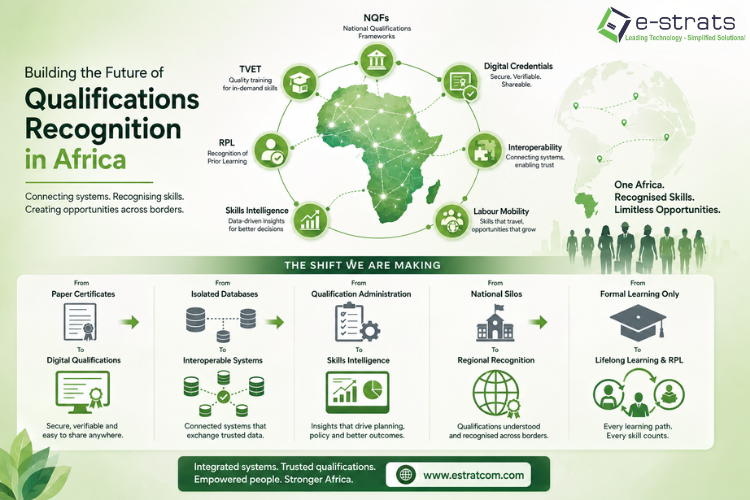
The goal is to create qualifications systems where skills are visible, trusted, portable and usable across Africa.
Conclusion
Qualifications Recognition in Africa is more than an administrative process. It is becoming an important part of Africa’s workforce and economic infrastructure.
Effective recognition can help strengthen TVET, skills mobility, labour-market alignment, RPL, employer confidence, qualifications portability and regional integration.
For African governments, TVET authorities, NQF agencies and development partners, the opportunity is to move beyond framework development and build connected, digital and sustainable qualifications ecosystems.
The future of Africa’s workforce will depend not only on how many people are trained, but on how effectively their skills can be recognised and connected to opportunity.
How e-strats Supports TVET & NQF Digital Transformation?
e-strats supports governments, TVET authorities, qualification agencies and development partners with TVET and NQF digital transformation solutions covering qualification management, accreditation, institute registration, monitoring and evaluation, qualification registries, testing, certification, credential verification, tracer studies and data analytics.
