
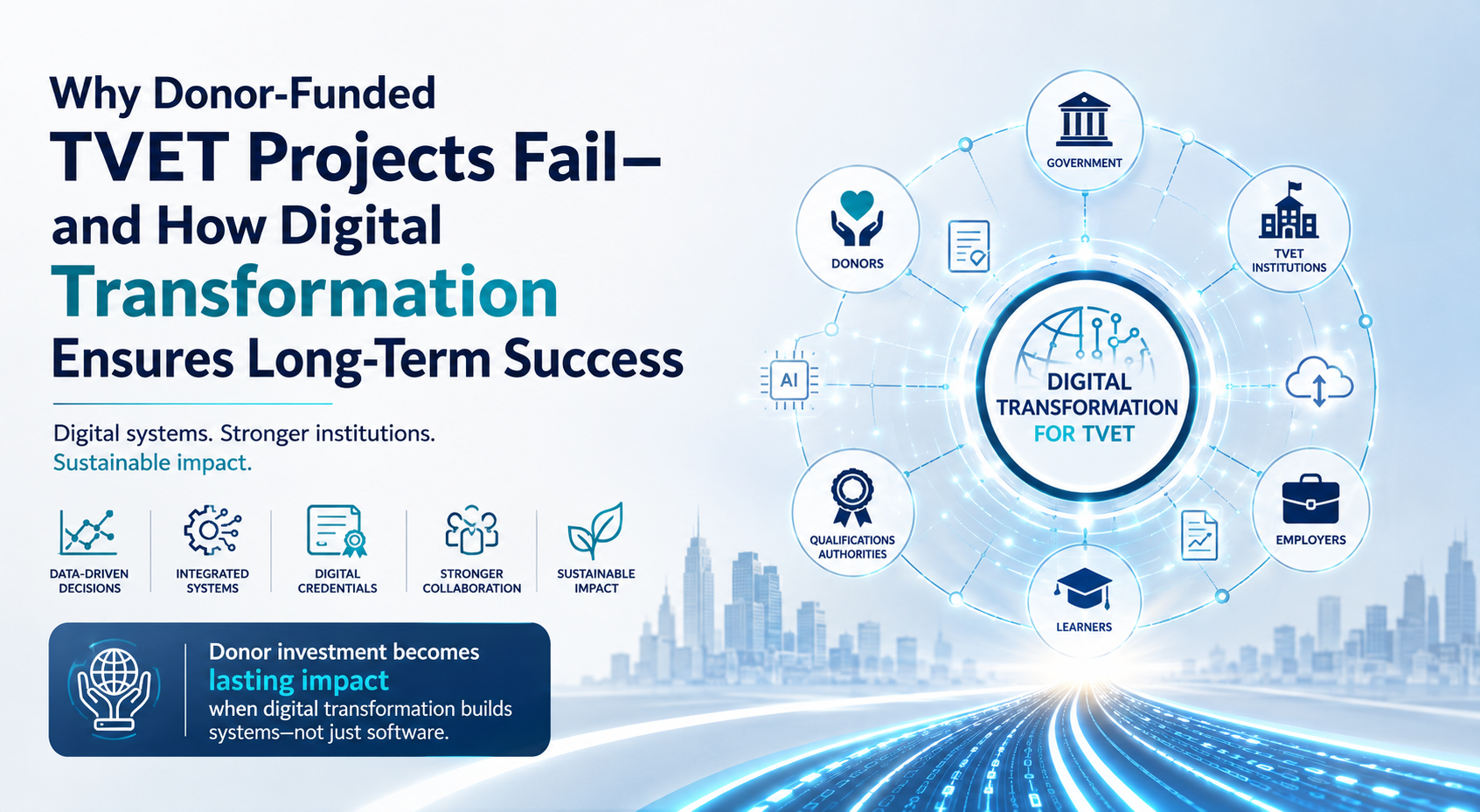
What happens when the project ends?
A new training center may be built. Hundreds of trainers may be trained. A digital platform may be deployed. Thousands of learners may benefit.
But if the systems, data, processes, and institutional capabilities cannot continue operating and evolving after donor funding ends, the long-term return on that investment is limited.
However, if these systems, data, processes, and institutional capabilities cannot continue operating and evolving after donor funding ends, the long-term return on investment remains limited.
The most successful donor-funded TVET initiatives are increasingly moving beyond short-term project outputs toward scalable, interoperable, measurable, and nationally owned digital ecosystems.
Why Do Donor-Funded TVET Projects Struggle After Implementation?
A TVET project can meet its initial targets and still struggle to create lasting institutional impact.
The underlying issue is often not funding alone. It is the absence of a sustainable digital and institutional foundation.
Several recurring challenges can undermine long-term success.
1. Sustainability Is Considered Too Late
Many projects are designed around a fixed implementation period:
Project design → Implementation → Training → Handover → Project closure
The problem is that TVET systems do not stop evolving when a project ends.
Institutions continue to enroll learners. Qualifications need to be reviewed. Employers’ skills requirements change. New occupations emerge. Policies evolve. Data requirements increase.
A system that was designed only for the initial project scope can quickly become outdated.
A sustainable TVET project should therefore answer questions such as:
- Who owns the platform after project closure?
- Who maintains and upgrades it?
- How will new institutions be onboarded?
- How will new qualifications be added?
- How will data standards evolve?
- How will operational costs be funded?
- Can the solution integrate with future government systems?
Sustainability is not a handover activity. It is an architectural and institutional requirement.
2. Pilot Projects Don't Always Scale
A pilot can demonstrate that a technology works.
But proving that something works in 10 institutions is very different from deploying it across 500 institutions or an entire national TVET system.
Scaling introduces new challenges:
- Different institutional structures
- Different data quality levels
- Different connectivity environments
- More users and transactions
- Additional government stakeholders
- New reporting requirements
- Integration with legacy systems
This is why scalability should be part of the initial TVET technology architecture.
A platform should be capable of moving from:
Pilot → Regional Implementation → National Rollout → Continuous Expansion
without requiring a complete rebuild at every stage.
For donors and governments, this creates a more sustainable investment model: build once, scale strategically, improve continuously.
3. Fragmented Systems Create Fragmented Outcomes
One of the biggest challenges facing modern TVET systems is fragmented:
- A ministry have one system.
- TVET institutions may use different management platforms.
- An NQF authority operates a separate qualification registry.
- Assessment bodies may maintain independent databases.
- Employers may have no direct mechanism to verify credentials.
- Labour-market information may exist in another government system.
The result is a disconnected information environment.
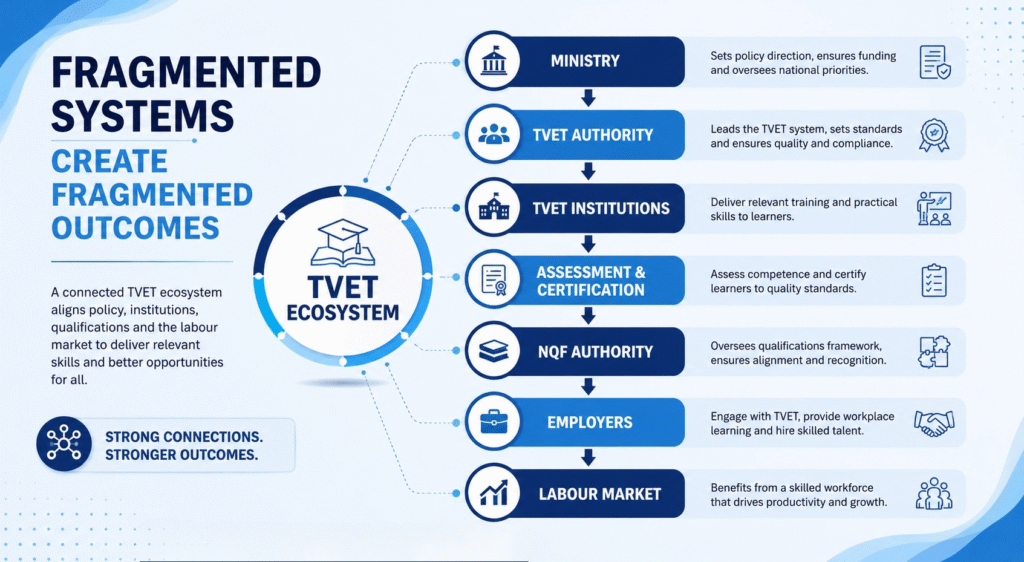
If these systems cannot communicate effectively, decision-makers may not have a complete picture of the national skills ecosystem.
This is where TVET interoperability becomes critical.
Lorem ipsum dolor sit amet, consectetur adipiscing elit. Ut elit tellus, luctus nec ullamcorper mattis, pulvinar dapibus leo.
4. Interoperability Should Be Designed From the Beginning
Digital transformation should not create another isolated platform.
A sustainable TVET management information system should be capable of exchanging information with relevant national and institutional systems.
Depending on the country’s architecture, this may include:
- Education management information systems
- National learner registries
- NQF registries
- Qualification management systems
- Accreditation systems
- Assessment systems
- Digital credential platforms
- Labour-market information systems
- Employment services
- Government identity systems
- Financial and administrative systems
The objective is not necessarily to replace everything.
The objective is to connect the right systems and establish trusted data flows.
This approach protects existing investments while creating a stronger foundation for future digital transformation.
5. Manual Systems Limit Transparency and Reporting
Donor-funded TVET projects are expected to demonstrate results.
Yet reporting can become one of the most difficult aspects of project management when information is collected manually.
Teams may spend significant time:
- Collecting spreadsheets
- Cleaning data
- Reconciling institutional reports
- Preparing donor reports
- Verifying performance figures
- Consolidating regional data
This creates delays and increases the risk of inconsistent information.
A digitally enabled TVET monitoring and evaluation environment can provide a different approach.
Instead of waiting for quarterly or annual reports, authorized stakeholders can access structured information on:
- Enrollment
- Completion
- Certification
- Institutional performance
- Trainer participation
- Program delivery
- Employment outcomes
- Regional performance
- Project indicators
This makes monitoring more continuous and evidence-based.
6. Donors Need More Than Activity Reports
Counting activities is important—but it does not tell the complete story.
For example:
10,000 learners trained
is an important project output.
But decision-makers also need to understand:
- How many completed their programs?
- How many achieved recognized qualifications?
- How many entered employment?
- Which programs produced the strongest outcomes?
- Which institutions performed best?
- Which regions need additional support?
- Are skills aligned with employer demand?
This is where measurable TVET outcomes become more important than simple implementation statistics.
Digital systems can help connect project activities to institutional and national outcomes.
From:
Inputs → Activities → Outputs
to:
Inputs → Activities → Outputs → Outcomes → Impact
That shift is essential for demonstrating the long-term value of donor investment.
7. Weak Stakeholder Engagement Can Undermine Adoption
Even the best TVET technology can fail if stakeholders do not use it.
Digital transformation affects many groups:
- Ministry officials
- TVET authorities
- NQF authorities
- Institutional managers
- Trainers
- Assessors
- Learners
- Employers
- Development partners
Each group has different priorities and workflows.
A successful digital transformation therefore requires more than technical implementation.
It requires:
Stakeholder engagement
Users should understand why the system is being introduced and how it improves their work.
Capacity building
Staff need the knowledge and confidence to use new digital processes.
Change management
Organizations need support in transitioning from existing workflows to new ones.
Continuous improvement
User feedback should influence future platform improvements.
Technology adoption is ultimately an organizational transformation challenge, not simply an IT deployment.
8. NQF Digital Transformation Is a Critical Part of Sustainability
National Qualifications Frameworks provide an important structure for qualifications, progression, recognition, and skills development.
But an NQF becomes difficult to manage at scale when qualification information remains distributed across documents, spreadsheets, emails, and disconnected databases.
To resolve this, NQF digital transformation can support an end-to-end qualification lifecycle:
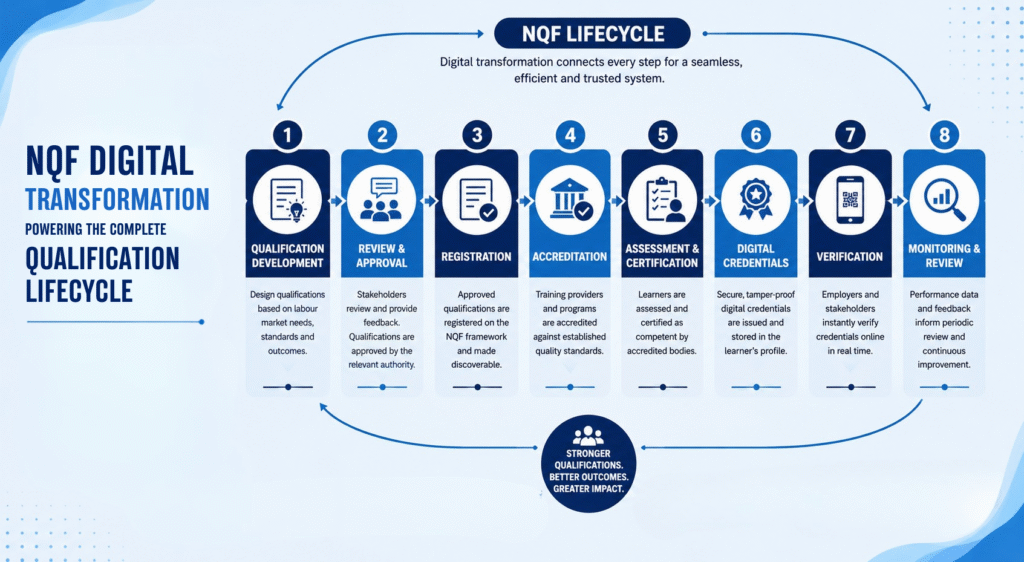
A digital qualification ecosystem can provide authorities with better visibility over qualifications while improving access to trusted information for institutions, learners, employers, and policymakers.
9. Digital Credentials Can Extend Project Impact
One of the most important principles for donor-funded TVET digital transformation is simple:
The project should be designed as part of the country’s long-term digital ecosystem—not as a standalone donor project.
This means aligning technology with:
- National TVET strategies
- National digital strategies
- NQF policies
- Data governance frameworks
- Labour-market priorities
- Existing government systems
- Institutional capabilities
- Long-term financing models
The donor project becomes a catalyst for national transformation rather than an isolated technology intervention.
10. Build for the National Ecosystem, Not Just the Project
A certificate issued at the end of a training program is only useful if stakeholders can trust and verify it.
Digital credentials can make qualifications easier to:
- Verify
- Share
- Validate
- Track
- Recognize
For employers, this approach directly reduces verification friction. Simultaneously, for learners, it significantly improves the portability of their achievements. For qualification authorities, it strengthens operational transparency and trust. As a result, for governments, it creates a far stronger, data-driven foundation for national skills management.
Digital credentials are therefore not merely a technical upgrade—they can become part of a broader national qualifications and workforce infrastructure.
What Does Sustainable TVET Digital Transformation Look Like?
A sustainable digital TVET ecosystem should bring together five critical capabilities.
- Scalable
The solution can grow from pilot institutions to national implementation.
- Interoperable
It can exchange information with existing and future government systems.
- Data-Driven
Authorities can access trusted information for monitoring and policymaking.
- User-Centered
Institutions, trainers, learners, employers, and regulators can actually adopt and use it.
- Sustainable
The country has the capacity, governance, infrastructure, and operating model to maintain and continuously improve the solution.
Together, these capabilities transform a technology project into a long-term digital TVET ecosystem.
How Integrated Digital Platforms Can Change the Model?
An integrated digital platform can provide a common technology foundation across the TVET ecosystem.
Instead of separate solutions for every process, authorities can establish connected capabilities.
These capabilities can be integrated according to national requirements rather than forcing every country into the same technology model.
The result is a more connected environment where data can move across the ecosystem and decision-makers can access the information they need.
From Donor Project to National Digital Asset
The ultimate goal of a donor-funded digital TVET project should not be:
“We successfully deployed the platform.”
The stronger goal is:
“The country continues using, scaling, integrating, and improving the platform long after the project ends.”
That is the difference between a project deliverable and a national digital asset.
A successful investment should leave behind:
- Stronger institutions
- Better digital capabilities
- Connected systems
- Trusted data
- Sustainable processes
- Measurable outcomes
- Greater national ownership
This is what makes digital transformation sustainable.
How e-strats Supports Sustainable TVET & NQF Digital Transformation?
At e-strats, we help governments, TVET authorities, NQF authorities, and development partners to digital transformation of TVET & NQF and skills-development strategies into scalable digital solutions.
Our approach goes beyond implementing a standalone platform.
We focus on building connected ecosystems that can support:
TVET Management + NQF Management + Digital Credentials + Accreditation + Registries + Monitoring & Evaluation + Analytics + AI
Ultimately, the objective is to help stakeholders move from fragmented processes and disconnected information toward integrated, data-driven, and sustainable TVET systems.
For development partners, this approach ensures that technology investments are designed around long-term national priorities rather than short-term project outputs. Meanwhile, for governments and TVET authorities, it provides a clear pathway to build digital infrastructure that evolves alongside the country’s growing skills ecosystem.
The Future of Donor-Funded TVET Projects Is Digital—and Sustainable
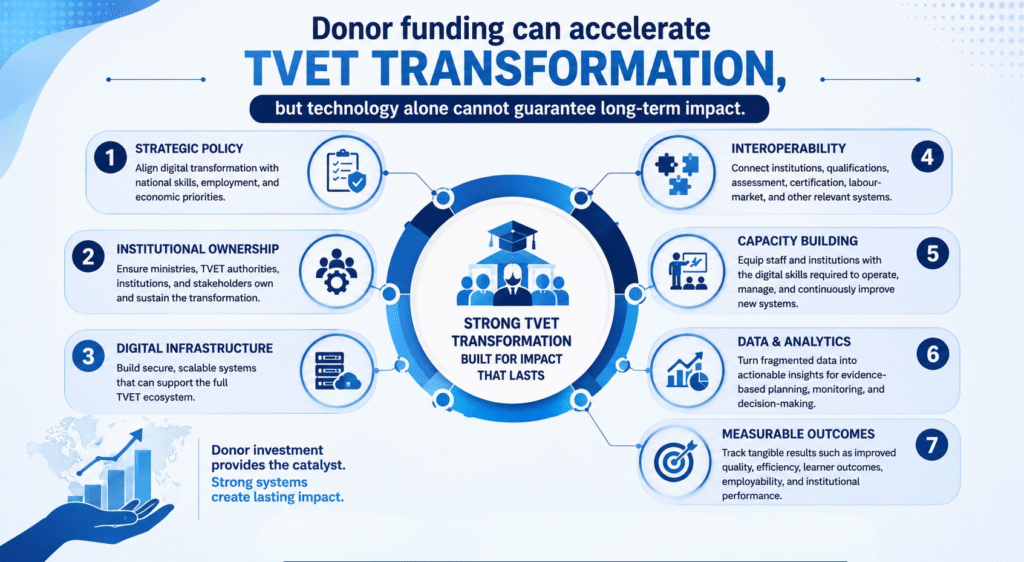
Donor funding can accelerate TVET transformation, but technology alone cannot guarantee long-term impact.
Consequently, the strongest projects must combine several critical pillars:
- Strategic Policy
- Institutional Ownership
- Digital Infrastructure
- Interoperability
- Capacity Building
- Data & Analytics
- Measurable Outcomes
When these elements work together, donor-funded projects can move beyond temporary interventions and become foundations for sustainable national TVET and NQF transformation.
As a result, the core question for governments and development partners is no longer simply:
“What can this project deliver?”
It should be:
“What digital capability will this investment leave behind—and how will it continue creating value ten years from now?”
That is the real measure of sustainable TVET digital transformation.
Frequently Asked Questions
What makes a TVET project sustainable after donor funding ends?
Sustainability depends on national ownership, scalable technology, local capacity, interoperability, sustainable operating models, stakeholder adoption, and continuous measurement of outcomes.
Why is digital transformation important for TVET systems?
Digital transformation can connect institutions, improve data management, automate workflows, strengthen monitoring, support evidence-based policymaking, and improve access to qualifications and credentials.
What is TVET interoperability?
TVET interoperability is the ability of different systems and stakeholders within the TVET ecosystem to exchange and use information effectively. This can include TVET management systems, NQF registries, accreditation platforms, learner records, credential systems, and labour-market information systems.
How can donors measure the impact of digital TVET projects?
Donors can combine implementation indicators with outcome indicators such as system adoption, processing-time reductions, data quality, institutional performance, certification, employment outcomes, and evidence of improved decision-making.
How can NQF authorities benefit from digital transformation?
Digital NQF solutions can support qualification lifecycle management, registration, accreditation, certification, digital credentials, verification, reporting, and stakeholder access to trusted qualification information.
What should governments consider when selecting a TVET technology partner?
Governments should evaluate TVET domain expertise, scalability, interoperability, data governance, cybersecurity, user adoption, implementation capacity, sustainability, analytics capabilities, and the provider’s ability to support long-term transformation.
