
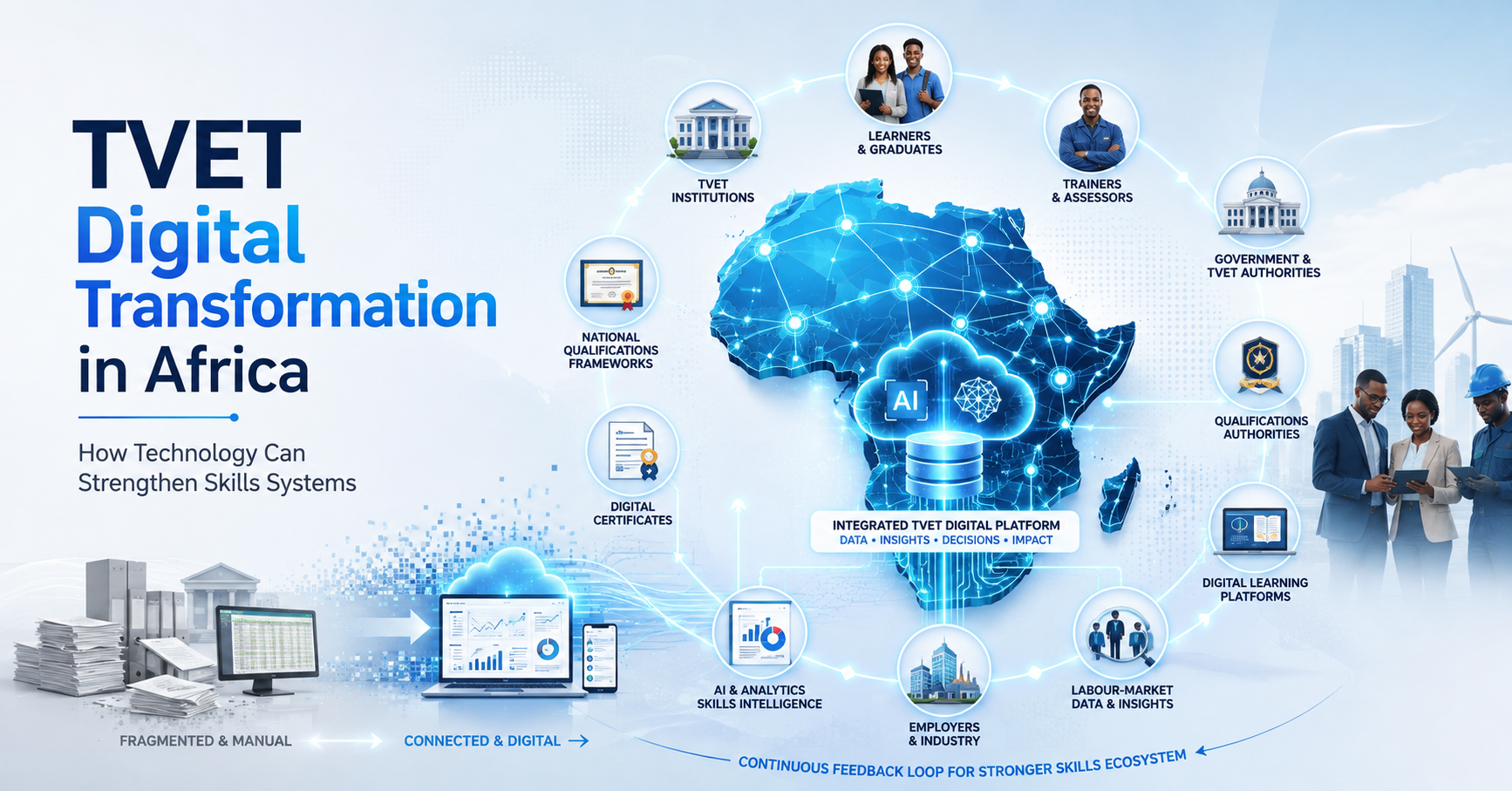
Technical and Vocational Education and Training (TVET) plays a critical role in preparing Africa’s workforce for changing labour markets, emerging industries, and economic growth. Yet many TVET systems across the continent still depend on fragmented information, manual processes, paper-based records, disconnected databases, and limited access to real-time skills data.
TVET digital transformation in Africa offers an opportunity to address these challenges by connecting institutions, qualifications authorities, learners, assessors, employers, and policymakers through integrated digital systems.
Digital transformation is not simply about putting existing forms online or introducing an e-learning platform. A successful digital TVET system connects the entire skills development ecosystem—from institutional registration and qualification development to assessment, certification, monitoring, graduate tracking, and employment outcomes.
This is increasingly important as African economies respond to digitalization, automation, green industries, and changing workforce requirements. The African Continental TVET Strategy 2025–2034 identifies digital and green transformation as one of the areas requiring action, alongside policy, governance, quality, inclusion, partnerships, and institutional development.
What Is TVET Digital Transformation?
TVET digital transformation is the strategic use of digital technologies, data, automation, artificial intelligence, cloud platforms, and integrated information systems to improve how technical and vocational education and training is governed, delivered, monitored, and continuously improved.
It involves transforming both technology and processes.
For example, a traditional TVET ecosystem may have:
- Separate databases for training institutions
- Paper-based accreditation applications
- Manual qualification approval processes
- Spreadsheet-based reporting
- Disconnected assessment records
- Limited graduate tracking
- Delayed monitoring reports
- Difficult certificate verification
- Limited labour-market intelligence
A digitally transformed TVET ecosystem can bring these functions together through interconnected platforms.
This can include:
- Digital institute registration and affiliation
- Online accreditation management
- Digital qualification development and management
- Learner and assessment management
- National qualification framework (NQF) or national vocational qualification framework (NVQF) registries
- Digital certification and credential verification
- TVET monitoring and evaluation
- Graduate tracer studies
- Skills intelligence and labour-market analytics
- AI-powered decision support
- Real-time dashboards
- Mobile applications
- API-based system integration
UNESCO-UNEVOC describes digital transformation in TVET as affecting teaching and learning, digital skills, institutional processes, planning, and the wider TVET ecosystem—not simply the delivery of courses online.
That distinction is critical for African TVET systems.
Why Africa Needs Digital TVET Systems?
Africa is experiencing major demographic, technological, and economic changes. TVET systems must respond to these changes while helping young people and adults develop relevant skills.
Digitalization is changing the skills required by employers, while digital technologies are also changing how education and training can be delivered and managed.
UNESCO-UNEVOC highlights the importance of digital skills and notes that African TVET systems face challenges related to connectivity, infrastructure, digital competencies, and the ability to identify emerging skills requirements.
At the same time, the African Continental TVET Strategy 2025–2034 places technology and innovation within the foundations of stronger TVET systems and includes digital and green transformation among its recommended areas of action.
This creates a clear opportunity for governments, qualifications authorities, TVET institutions, development partners, and technology providers to build more connected and data-driven TVET ecosystems.
1. Centralized TVET Data Can Improve Decision-Making
One of the biggest barriers to effective TVET governance is fragmented data.
Information about institutions, qualifications, learners, assessments, trainers, employment outcomes, and accreditation may exist in different systems or spreadsheets.
When data is disconnected, policymakers have difficulty answering basic questions:
- How many accredited TVET institutions are operating?
- Which qualifications are being offered?
- Which qualifications are most relevant to employers?
- How many learners complete their training?
- What are graduate employment rates?
- Which institutions require additional support?
- Where are skills shortages emerging?
- Which programmes need to be updated?
A centralized TVET data management system can provide a common information environment for authorized stakeholders.
Real-time dashboards can then transform raw information into actionable indicators for policymakers and TVET managers.
Instead of waiting for periodic reports, decision-makers can monitor performance continuously.
2. Digital Qualification Management Can Strengthen NQF Systems
National Qualifications Frameworks (NQFs) and National Vocational Qualifications Frameworks (NVQFs) are essential for organizing qualifications, levels, learning outcomes, competencies, and progression pathways.
However, managing qualifications manually becomes increasingly difficult as the number of programmes, institutions, standards, and stakeholders grows.
A digital qualification management platform can provide:
- Centralized qualification repositories
- Version control
- Qualification approval workflows
- Competency and learning-outcome mapping
- NQF/NVQF level management
- Credit and outcome mapping
- Review and renewal workflows
- Stakeholder access controls
- Digital audit trails
This makes it easier for qualifications authorities to maintain accurate and up-to-date qualification information.
Digital NQF infrastructure can also support greater transparency by providing authorized stakeholders with access to verified qualification data.
For countries modernizing their qualification frameworks, NQF digital transformation should therefore be considered a core component of broader TVET reform.
3. Digital Accreditation Can Improve Quality Assurance
Accreditation is another area where digital transformation can create significant value.
Traditional accreditation processes may involve paper applications, physical documentation, manual evaluation, site visits, spreadsheets, and lengthy approval processes.
A digital accreditation management system can automate much of this lifecycle.
For example:
Application → Document Verification → Evaluation → Inspection → Compliance Review → Approval → Renewal
Each stage can be tracked digitally.
TVET authorities can also use automated alerts to identify:
- Expiring accreditations
- Missing documents
- Compliance gaps
- Pending evaluations
- Delayed approvals
- Institutions requiring follow-up
This creates a more transparent and traceable quality assurance process.
For national TVET systems, digital accreditation is therefore not simply an administrative convenience—it can become part of a broader TVET quality assurance digital transformation strategy.
4. AI Can Support TVET Decision-Making
Artificial intelligence is becoming increasingly relevant to TVET.
AI can help analyze large volumes of information from qualifications, labour markets, learner performance, institutional data, and employment outcomes.
For example, AI in TVET can support:
Skills gap analysis
AI-powered analytics can identify patterns in qualification demand, labour-market requirements, and skills shortages.
Qualification relevance
AI can help identify qualifications that may require review because employer requirements or occupational profiles are changing.
Predictive analytics
Historical data can be used to identify trends and potential risks across institutions, programmes, and learner outcomes.
Personalized career guidance
AI systems can analyze learner profiles, competencies, qualifications, and career interests to suggest potential pathways.
Automated reporting
AI can assist authorities in transforming large datasets into summaries, reports, and decision-support insights.
Monitoring and evaluation
AI-enhanced analytics can help identify performance trends, anomalies, and areas requiring intervention.
The goal should not be to replace TVET policymakers or experts with AI. Instead, AI-powered TVET systems should give decision-makers better information so they can make faster and more evidence-based decisions.
UNESCO’s recent work on AI and digital tools in TVET highlights areas including labour-market alignment, personalized learning, career guidance, job matching, and connected systems.
5. Digital Skills Must Be Embedded Into TVET Programmes
Digital transformation cannot succeed if TVET institutions simply digitize their administration while continuing to teach outdated occupational skills.
The workforce itself is changing.
Learners increasingly need a combination of:
- Foundational digital skills
- Digital literacy
- Sector-specific digital skills
- Data literacy
- Digital entrepreneurship
- AI awareness
- Cybersecurity awareness
- Technology-enabled problem-solving
TVET curricula therefore need mechanisms for identifying and integrating emerging competencies.
This requires stronger links between:
Labour Market → Skills Intelligence → Occupational Standards → Qualifications → Curriculum → Assessment → Employment
Digital platforms can help connect these elements.
UNESCO-UNEVOC research has highlighted a key challenge for African TVET systems: digital transformation needs to address not only digital delivery of education but also the changing digital skills requirements of workplaces and occupations.
6. Digital Monitoring and Evaluation Can Strengthen TVET Governance
Monitoring and evaluation (M&E) is essential for understanding whether TVET reforms are achieving their objectives.
However, manual reporting can create delays and inconsistencies.
A digital TVET monitoring and evaluation system can collect information from institutions and other stakeholders and consolidate it into standardized indicators.
Authorities can monitor:
- Enrolment
- Completion
- Assessment results
- Certification
- Accreditation status
- Trainer performance
- Institutional performance
- Employment outcomes
- Gender participation
- Regional participation
- Skills demand
- Graduate outcomes
Interactive dashboards can then provide different levels of access.
For example:
National level: Policy and strategic indicators
Regional level: Institutional and programme performance
Institution level: Learner, trainer, and operational indicators
Programme level: Qualification and employment outcomes
This creates a more evidence-based approach to TVET governance and policy planning.
7. Graduate Tracking Can Connect TVET to Employment
The ultimate purpose of TVET is not simply to issue certificates. It is to develop relevant skills that improve employability, productivity, entrepreneurship, and economic participation.
This makes graduate tracking particularly important.
A digital TVET tracer study system can help authorities understand what happens after learners complete training.
Data can include:
- Employment status
- Occupation
- Employer sector
- Time to employment
- Further education
- Entrepreneurship
- Income progression
- Skills relevance
- Employer satisfaction
This information can then feed back into qualification and curriculum development.
For example:
Graduate Data → Employment Trends → Skills Gap → Qualification Review → Curriculum Update
This creates a continuous improvement cycle.
8. Online Credential Verification Can Build Trust
As qualifications become increasingly digital, employers and institutions need reliable ways to verify credentials.
A digital credential verification system can allow authorized users to verify:
- Certificates
- Qualifications
- Transcripts
- Learner records
- Qualification levels
- Issuing institutions
This can reduce administrative delays and help protect the integrity of national qualifications.
For countries with large and geographically distributed TVET systems, online verification can also make qualification validation more accessible to employers and institutions.
9. System Integration Is Critical
One of the most important principles of TVET digital transformation is interoperability.
Creating another isolated platform does not solve the problem of fragmented data.
A modern TVET ecosystem may need to connect:
- TVET management systems
- NQF/NVQF registries
- Learning management systems
- Accreditation platforms
- Assessment systems
- Certification systems
- EMIS platforms
- Labour-market information systems
- Government databases
- Employer systems
APIs and common data standards can allow these systems to exchange information securely.
This creates a connected digital ecosystem rather than a collection of disconnected applications.
The importance of ecosystem-level transformation is reflected in UNESCO’s Pan-African digital transformation initiative, which emphasizes national networks, coordination structures, digital policies, skills development, and institutional capacity rather than technology deployment alone.
10. Digital Transformation Must Work in Low-Connectivity Environments
One of the biggest mistakes in designing digital TVET solutions for Africa is assuming that every institution has reliable high-speed internet.
Connectivity, device availability, infrastructure, digital skills, and affordability remain important considerations.
Therefore, African TVET technology should consider:
- Mobile-first interfaces
- Offline functionality
- Data synchronization
- Lightweight applications
- Local data caching
- Multilingual interfaces
- Cloud and hybrid deployment options
- Role-based access
- Secure data synchronization
An offline-first TVET system can allow users to continue collecting information when connectivity is limited and synchronize data when an internet connection becomes available.
This approach is particularly relevant for rural and geographically dispersed training institutions.
The Role of Development Partners in TVET Digital Transformation
Successful TVET digital transformation in Africa requires collaboration. Governments and qualifications authorities provide policy direction and institutional ownership. TVET institutions provide operational expertise. Employers contribute information about labour-market requirements.
Development partners can support financing, capacity building, technical assistance, and institutional reform. Technology partners can provide the digital infrastructure, system integration, software development, analytics, and implementation expertise required to turn strategy into operational systems. This collaborative model is consistent with the African Continental TVET Strategy 2025–2034, which emphasizes partnerships, knowledge sharing, institutional development, technology, and innovation.
A Practical Roadmap for TVET Digital Transformation in Africa
A successful digital transformation programme should not begin with buying software.
It should begin with a clear assessment of the existing ecosystem.
Step 1: Assess the Current Digital Maturity
Identify existing systems, databases, processes, infrastructure, skills, policies, and data gaps.
Step 2: Define the National Digital TVET Strategy
Establish clear priorities, governance structures, implementation responsibilities, and measurable outcomes.
Step 3: Prioritize High-Impact Processes
Start with processes that create significant administrative or policy value, such as institute registration, accreditation, qualification management, certification, or M&E.
Step 4: Establish a Common Data Architecture
Define how information will be structured, stored, exchanged, secured, and governed.
Step 5: Integrate Existing Systems
Use APIs and interoperability standards to connect existing investments rather than unnecessarily replacing every system.
Step 6: Build Digital Capacity
Train TVET managers, teachers, assessors, administrators, policymakers, and technical teams.
Step 7: Introduce Analytics and AI
Once reliable data is available, AI and advanced analytics can be introduced to support forecasting, monitoring, decision-making, and personalization.
Step 8: Measure Outcomes
Track indicators such as:
- System adoption
- Processing time
- Data quality
- Accreditation turnaround
- Learner completion
- Employment outcomes
- Qualification relevance
- Institutional performance
Step 9: Scale Sustainably
Successful pilots should be converted into scalable national or regional platforms with sustainable governance, funding, maintenance, and capacity-building models.
Common Challenges in TVET Digital Transformation
Digital transformation can deliver major benefits, but it is not without challenges.
Fragmented systems
Different institutions may use different databases and technologies.
Solution: Develop an interoperability and integration strategy.
Limited digital infrastructure
Connectivity and hardware limitations can restrict adoption.
Solution: Use mobile-first, cloud, hybrid, and offline-capable approaches where appropriate.
Resistance to change
Staff may be accustomed to manual processes.
Solution: Combine technology deployment with change management, training, and continuous support.
Poor data quality
AI and analytics are only as useful as the underlying data.
Solution: Establish data standards, validation processes, governance, and clear ownership.
Lack of technical capacity
Institutions may struggle to maintain complex systems after deployment.
Solution: Include capacity building, documentation, knowledge transfer, and long-term technical support from the beginning.
Unsustainable pilot projects
A pilot may succeed technically but fail to scale nationally.
Solution: Design scalability, institutional ownership, financing, and sustainability into the project from day one.
What Does the Future of TVET in Africa Look Like?
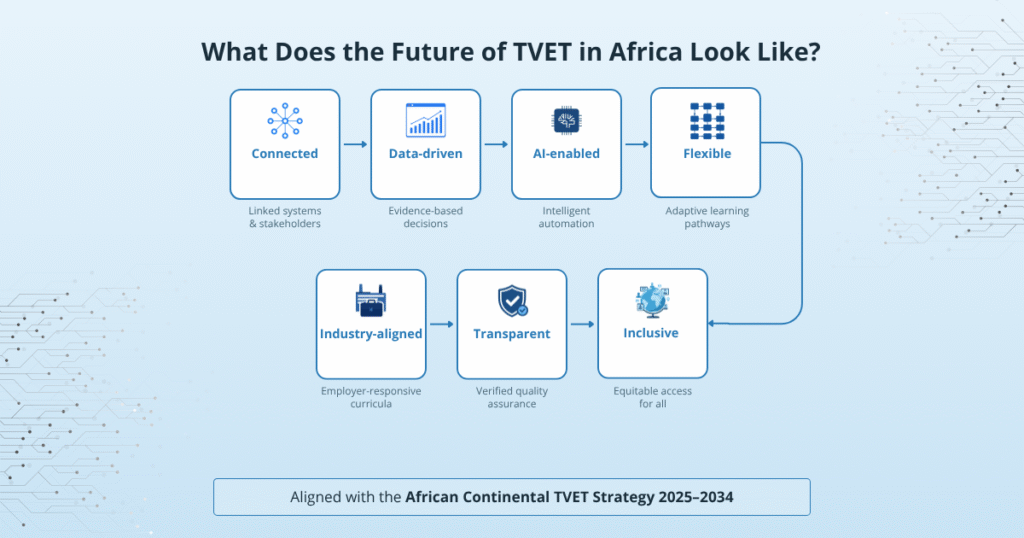
The future of TVET in Africa will increasingly depend on how effectively countries connect skills, technology, data, qualifications, and labour markets.
The next generation of TVET systems will likely be more:
Connected — Institutions and stakeholders can exchange trusted data.
Data-driven — Policymakers can monitor performance using real-time information.
AI-enabled — Intelligent analytics can support forecasting and decision-making.
Flexible — Learners can access more diverse learning and assessment pathways.
Industry-aligned — Qualifications respond more rapidly to labour-market changes.
Transparent — Accreditation, certification, and qualification information can be verified digitally.
Inclusive — Digital solutions can extend access to underserved communities when designed around local connectivity and accessibility realities.
The African Continental TVET Strategy 2025–2034 provides an important policy context for this transformation, with digital and green transformation included among its recommended action areas.
Building a Connected TVET Ecosystem
The real value of TVET digital transformation in Africa is not the introduction of individual technologies.
It is the creation of a connected ecosystem in which information can move securely between the organizations responsible for skills development.
Imagine a system where:
A learner enters a TVET programme → their qualification is linked to a national framework → assessment results are digitally recorded → certification is issued and verified online → employment outcomes are tracked → labour-market data identifies emerging skills gaps → qualifications are reviewed → curricula are updated → policymakers monitor the entire cycle through real-time analytics.
That is the potential of a digitally connected TVET ecosystem.
For governments, TVET authorities, qualifications agencies, development partners, and institutions, the priority should therefore be to move beyond isolated digitization projects and toward strategic, interoperable, sustainable digital transformation.
How e-strats Supports TVET Digital Transformation ?
e-strats can also serve as a technology partner for the digital transformation of Pakistan’s TVET ecosystem through the National Vocational Qualifications Framework (NVQF), supporting the development of connected digital infrastructure for qualifications, accreditation, institutions, assessment, credentials, and skills data.
Its TVET technology capabilities include qualification development and management, accreditation management, institute registration, monitoring and evaluation, NVQF registries, teacher training, tracer studies, testing services, online credential verification, dashboards, and AI-driven analytics.
These capabilities can help organizations move from fragmented and manual processes toward a connected digital TVET ecosystem.
The approach can also integrate with existing systems rather than requiring organizations to operate completely separate platforms. e-strats broader digital transformation capabilities include system integration, AI and data strategy, enterprise software, dashboards, and capacity building.
For education authorities and development organizations working on TVET reform, the objective should be clear:
Build digital infrastructure that strengthens the entire skills ecosystem—not just one process.
Conclusion
TVET digital transformation in Africa is becoming a strategic requirement for building future-ready skills systems.
The goal is not simply to replace paper with software. It is to create an integrated environment where qualifications, institutions, learners, assessments, employers, labour-market information, and policymakers are connected through trusted digital infrastructure.
When combined with strong governance, digital skills development, interoperability, analytics, and responsible AI adoption, digital transformation can help African TVET systems become more responsive, transparent, inclusive, and aligned with the future of work.
For countries investing in TVET reform, the question is no longer whether technology belongs in the skills ecosystem. The more important question is:
How can digital technology be strategically implemented to create a sustainable, connected, and labour-market-responsive TVET system?
That is where effective TVET digital transformation begins.
