
What Is Digital Transformation in TVET?
Digital transformation in TVET is the strategic use of digital technologies, data, connected systems, and redesigned processes to improve how skills systems are governed, delivered, monitored, and connected to labour-market needs.
More importantly, it can influence almost every part of the TVET ecosystem, including:
- Qualification development and management
- NQF administration
- Accreditation and institutional registration
- Curriculum and programme management
- Learner registration and records
- Assessment and certification
- Digital credentials
- Credential verification
- Teacher and trainer management
- Labour-market information
- Tracer studies
- Monitoring and evaluation
- Institutional performance
- Skills intelligence and forecasting
- Reporting and policy decision-making
Similarly, UNESCO-UNEVOC describes digital transformation as affecting teaching and learning, digital competencies, delivery processes, planning, and the wider organization of TVET provision.
However, digital transformation should not be confused with simply introducing individual digital tools. For example, buying an LMS, building a qualification registry, or launching an online portal can support digitalization, but none of these initiatives alone constitutes true transformation.
Instead, transformation occurs when technologies, data, people, and processes are connected to improve how the entire TVET system operates. As a result, the focus shifts from isolated digital solutions to a connected, integrated, and sustainable skills ecosystem.
What Is Digital Transformation in TVET?
Digital transformation in TVET is the strategic use of digital technologies, data, connected systems, and redesigned processes to improve how skills systems are governed, delivered, monitored, and connected to labour-market needs.
It can affect almost every part of the TVET ecosystem, including:
- Qualification development and management
- NQF administration
- Accreditation and institutional registration
- Curriculum and programme management
- Learner registration and records
- Assessment and certification
- Digital credentials
- Credential verification
- Teacher and trainer management
- Labour-market information
- Tracer studies
- Monitoring and evaluation
- Institutional performance
- Skills intelligence and forecasting
- Reporting and policy decision-making
UNESCO-UNEVOC similarly describes digital transformation as affecting teaching and learning, digital competencies, delivery processes, planning, and the wider organization of TVET provision.
This means that buying an LMS, building a registry, or launching an online portal may be part of digital transformation—but none of these initiatives alone constitutes transformation.
Pillar 1: Strategy & Governance
Digital transformation should begin with strategy, not technology.
A TVET authority may have access to modern platforms, cloud infrastructure, AI tools, and analytics. But without a clear national or institutional strategy, these technologies can create additional fragmentation rather than solving existing problems.
A successful TVET digital transformation strategy should establish:
- Clear transformation objectives
- Digital governance structures
- Policy and regulatory alignment
- Institutional responsibilities
- Data governance principles
- Cybersecurity and privacy requirements
- Investment and sustainability plans
- Technology standards
- Implementation priorities
- Monitoring and evaluation mechanisms
Why governance matters
TVET ecosystems typically involve multiple stakeholders:
Ministries → TVET Authorities → Institutions → Qualification Bodies → Assessment Bodies → Employers → Labour Markets
If each organization develops its own technology solution without a shared architecture or governance model, information becomes trapped in organizational silos.
The result can be:
Disconnected systems → duplicated data → manual processes → inconsistent information → weak decision-making
Digital transformation should instead establish a common direction for the ecosystem.
From technology projects to transformation strategy
Rather than asking:
“What software should we buy?”
decision-makers should ask:
“What problems are we trying to solve, which processes need to change, and what digital capabilities are required to achieve our national skills objectives?”
This shift—from technology-first thinking to strategy-first transformation—is one of the most important steps toward sustainable TVET digitalization.
Pillar 2: People & Institutional Capacity
Technology does not transform institutions. People do.
One of the most common risks in digital transformation projects is underestimating the human and institutional capabilities required to operate new systems.
A sophisticated platform will deliver limited value if staff do not have the skills, confidence, processes, or authority required to use it effectively.
TVET digital transformation therefore needs investment in:
- Digital skills for staff
- Teacher and trainer development
- Leadership capacity
- Digital change management
- System administration
- Data management
- Cybersecurity awareness
- Digital pedagogy
- Technical support
- Institutional ownership
- Continuous professional development
UNESCO-UNEVOC highlights the importance of supporting TVET teachers and trainers as digital transformation changes teaching, learning, and delivery processes.
Recent ILO work also demonstrates this principle in practice. In Bosnia and Herzegovina, more than 170 vocational teachers participated in a programme focused on digital content development and new approaches to vocational teaching.
Capacity building must go beyond training
A one-time training workshop is rarely enough.
Sustainable transformation requires:
Training → Practice → Support → Adoption → Continuous improvement
Staff need opportunities to apply new skills, access technical support, understand new workflows, and participate in improving the systems they use.
Institutional ownership is critical
Donor-funded projects can introduce technology quickly, but long-term sustainability depends on whether national institutions can eventually own, manage, maintain, and improve the resulting systems.
This makes institutional capacity a strategic pillar—not an optional project component.
Pillar 3: Digital Infrastructure & Technology
The third pillar is the technology foundation that enables digital TVET services.
This includes the platforms, applications, infrastructure, security controls, and digital services required to support the TVET ecosystem.
Depending on the country’s priorities, this may include:
- TVET management information systems
- NQF and qualification registries
- Accreditation management systems
- Institution registration platforms
- Assessment and certification systems
- Learner information systems
- Digital credential platforms
- Online verification services
- Learning management systems
- Teacher management systems
- Labour-market information systems
- Monitoring and evaluation platforms
- Data warehouses
- Analytics and AI solutions
- Mobile and web services
However, infrastructure should be designed around system requirements and user needs, rather than technology trends.
Build for scalability
TVET digital systems should be:
Secure — protecting institutional and learner information.
Scalable — capable of supporting growing numbers of users, institutions, qualifications, and records.
Accessible — designed for different users, locations, and levels of digital maturity.
Maintainable — supported by sustainable technical and institutional capabilities.
Interoperable — capable of exchanging information with other systems.
Avoid creating another digital silo
A new platform that cannot communicate with existing systems can simply create another information silo.
The goal should therefore not be:
“Digitize every process separately.”
The goal should be:
“Build a connected digital ecosystem in which processes and information can flow across the TVET system.”
Pillar 4: Data & Interoperability
Data is one of the most valuable assets within a modern TVET system.
But data becomes significantly more valuable when different systems can exchange, interpret, and use it effectively.
A fragmented TVET ecosystem may have separate databases for:
- Institutions
- Qualifications
- Learners
- Assessments
- Certificates
- Accreditation
- Employment
- Labour-market information
- Training providers
If these systems cannot communicate, decision-makers may have large amounts of data but limited visibility.
This is where interoperability becomes essential.
What does interoperability mean in TVET?
Interoperability enables different digital systems and organizations to exchange and use information through agreed standards, structures, and interfaces.
For example:
Qualification Registry
↓
Accreditation System
↓
Institution Management System
↓
Assessment & Certification System
↓
Digital Credential
↓
Verification Platform
↓
Employer / Labour Market
Instead of repeatedly entering the same information into different systems, trusted data can move through the qualification lifecycle.
From data collection to skills intelligence
The objective is not simply to collect more data. The objective is to turn data into actionable intelligence. TVET authorities can use integrated data to answer questions such as:
- Which skills are in demand?
- Which qualifications are producing employment outcomes?
- Which institutions are performing well?
- Where are skills shortages emerging?
- Which programmes need updating?
- How many graduates transition into employment?
- Which sectors require new occupational standards?
- Where should training investment be prioritized?
UNESCO’s TVET strategy emphasizes systematic data collection and analysis, including the use of digital information and indicators to support monitoring and evidence-based decision-making.
The result is a shift:
Data → Information → Intelligence → Better decisions
Pillar 5: Processes & Measurable Outcomes
Digital transformation should ultimately improve how the system works and what it achieves.
Simply digitizing an inefficient manual process does not necessarily make it better.
For example:
Paper application → Online application is digitization.
But:
Redesigning the entire registration process → Automating validation → Integrating payment → Connecting accreditation → Generating real-time status updates → Providing analytics
is closer to genuine digital transformation.
Process transformation should focus on the user
TVET digital services should make processes simpler for:
- Learners
- Teachers
- Institutions
- Employers
- Assessors
- Qualification developers
- Accreditation bodies
- TVET authorities
- Ministries
The transformation should reduce unnecessary administrative work while improving transparency, speed, quality, and accountability.
Measure what matters
A successful digital transformation programme should define measurable outcomes from the beginning. Potential indicators include:
- Reduced processing time
- Reduced administrative costs
- Increased system adoption
- Faster accreditation processes
- Improved qualification management
- Faster certificate verification
- Improved data quality
- Increased institutional participation
- Better learner tracking
- Improved employment outcomes
- Stronger labour-market alignment
- Better policy decision-making
The World Bank has highlighted the importance of strengthening TVET systems around learners and enterprises, improving data and evaluation, and shifting attention from inputs toward outcomes.
The key question is therefore not:
“Did we deploy the platform?”
It is:
“Did the platform improve the TVET system?”
How the 5 Pillars Work Together in Digitization of TVET?
The five pillars should not be treated as independent workstreams.
They form a connected transformation model.
Strategy & Governance
Defines where the system needs to go.
↓
People & Institutional Capacity
Ensures organizations have the capability to get there.
↓
Digital Infrastructure & Technology
Provides the platforms and digital foundation.
↓
Data & Interoperability
Connects information, systems, and stakeholders.
↓
Processes & Measurable Outcomes
Ensures the transformation produces tangible results.
This creates a continuous cycle:
Strategy → Capability → Technology → Data → Outcomes → Improvement
The outcome is a TVET system that can continuously adapt to changes in technology, industry, skills demand, and labour markets.
What Happens When One Pillar Is Missing?
The five pillars are interdependent. Weakness in one area can undermine the entire transformation programme.
Missing Pillar | Potential Result |
Strategy & Governance | Disconnected technology investments |
People & Capacity | Low adoption and dependence on external support |
Digital Infrastructure | Manual processes and limited digital services |
Data & Interoperability | Information silos and poor visibility |
Processes & Outcomes | Technology without measurable impact |
This is why successful digital transformation requires a whole-system approach.
The ILO’s framework for national TVET and skills-system digitalization similarly emphasizes a coordinated approach across major functions of the skills system rather than treating digitalization as a standalone technology initiative.
From Fragmented Systems to a Connected TVET Ecosystem
Many TVET systems have evolved through individual projects.
One project may create an NQF registry.
Another may introduce an accreditation platform.
Another may develop an LMS.
Another may establish a labour-market information system.
Another may digitize certification.
Each initiative may have value. But if these systems are not designed to work together, the overall ecosystem can remain fragmented.
Digital transformation provides an opportunity to move from:
Fragmented systems → Connected ecosystems
Paper certificates → Digital credentials
Manual reporting → Real-time information
Static databases → Skills intelligence
Isolated projects → Sustainable digital infrastructure
Input monitoring → Outcome-based management
Administrative data → Evidence-based policy
This is particularly important as technology changes the nature of occupations and the skills required by employers. The ILO notes that digital transformation is affecting learning, assessment, certification, career guidance, job matching, and labour-market services.
The Role of AI in TVET Digital Transformation
Once the foundational digital ecosystem is in place, AI can add another layer of intelligence.
AI can potentially support:
- Skills-demand forecasting
- Qualification gap analysis
- Labour-market trend analysis
- Learner progression analysis
- Institutional performance analysis
- Automated reporting
- Document and data classification
- Intelligent search
- Policy decision support
- Early-warning systems
- Personalized learning recommendations
However, AI should not be treated as a substitute for the five foundational pillars.
AI without quality data is unreliable.
AI without interoperability is limited.
AI without institutional capacity is difficult to adopt.
AI without governance creates risks.
AI without measurable outcomes may simply become another technology project.
The strongest approach is therefore:
Digital foundation → Connected data → Skills intelligence → AI-enabled decision-making
How Donor-Funded TVET Projects Can Apply the 5-Pillar Model?
For development partners and donor-funded TVET programmes, the five pillars can provide a useful framework for designing sustainable interventions.
Instead of funding technology as an isolated project component, investment can be distributed across the transformation ecosystem:
Strategic Policy
Support national digital transformation strategies, governance frameworks, standards, and implementation roadmaps.
Institutional Ownership
Strengthen government and TVET authority capabilities to manage and sustain digital systems.
Digital Infrastructure
Develop secure, scalable platforms that support national TVET and NQF processes.
Interoperability
Ensure new systems can connect with existing and future platforms.
Capacity Building
Invest in technical teams, administrators, teachers, trainers, and institutional leaders.
Data & Analytics
Develop data governance, reporting, analytics, and skills-intelligence capabilities.
Measurable Outcomes
Define KPIs that demonstrate improvements in efficiency, quality, access, employability, and labour-market relevance.
This approach helps shift donor investment from short-term technology delivery toward long-term institutional transformation.
A Practical Roadmap for TVET Digital Transformation
Countries planning TVET digital transformation can begin with five practical steps.
Step 1: Assess the Current Ecosystem
Map existing:
- Policies
- Institutions
- Processes
- Databases
- Digital platforms
- Infrastructure
- Data flows
- Skills
- Governance structures
Identify duplication, gaps, bottlenecks, and disconnected systems.
Step 2: Define the Digital Transformation Strategy
Establish:
- Vision
- Priorities
- Governance
- Architecture
- Standards
- Investment requirements
- Implementation roadmap
- Sustainability model
Step 3: Prioritize High-Value Processes
Start with processes where digital transformation can deliver measurable value.
Examples include:
- Qualification management
- Accreditation
- Institution registration
- Assessment
- Certification
- Digital credential verification
- Learner tracking
- Monitoring and evaluation
Step 4: Build the Connected Digital Foundation
Develop systems using common standards and an architecture that supports:
Integration + Interoperability + Security + Scalability
Step 5: Measure, Learn, and Improve
Use system data to monitor performance and continuously improve policies, processes, services, and investments.
Digital transformation should therefore be treated as a continuous journey rather than a one-time IT project.
Conclusion: Digital Transformation Is a System Transformation
The future of TVET will not be determined simply by how many platforms a country deploys.
It will depend on how effectively countries connect:
Policy + People + Technology + Data + Processes
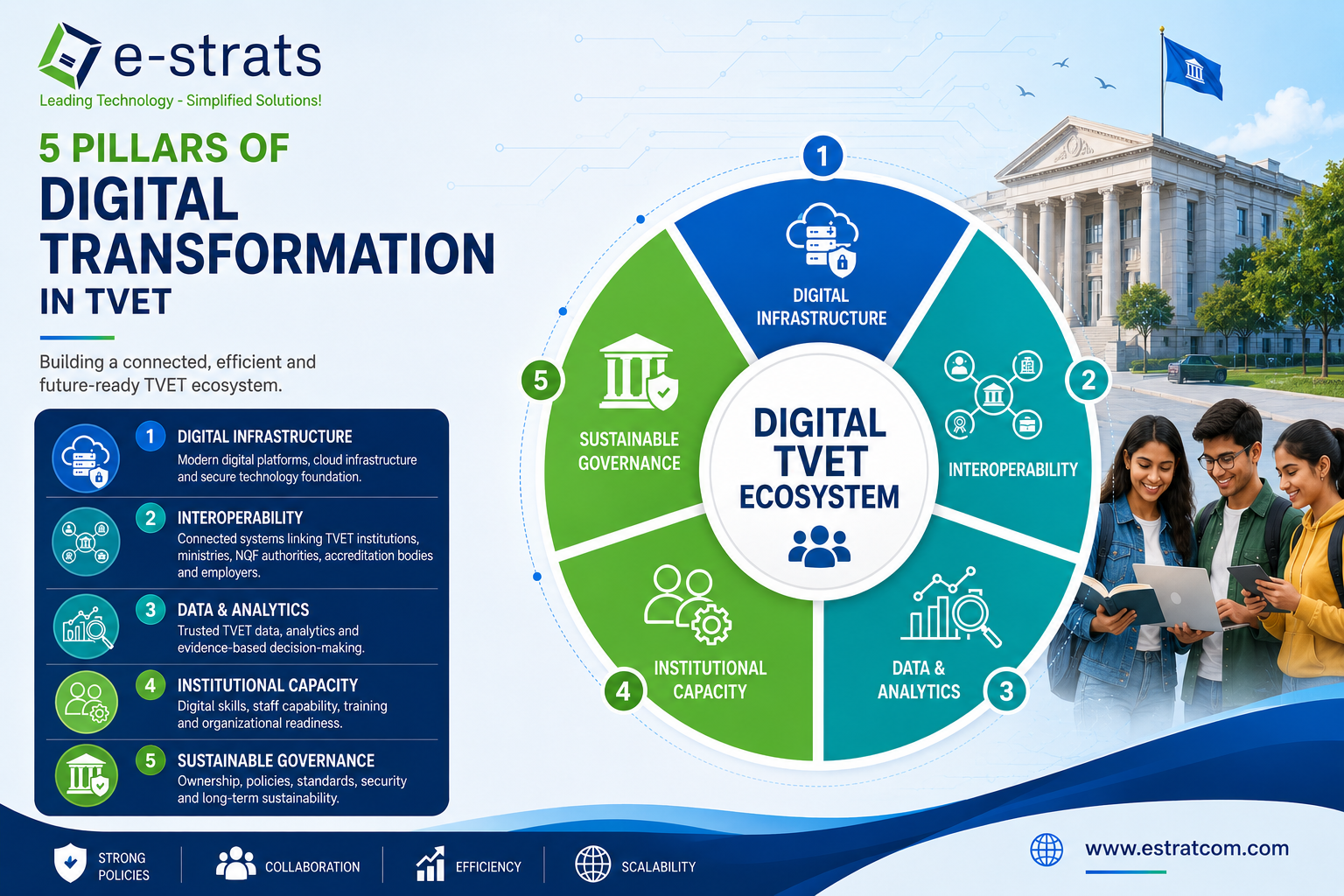
The five pillars of TVET digital transformation provide a practical way to think about this challenge:
- Strategy & Governance
2. People & Institutional Capacity
3. Digital Infrastructure & Technology
4. Data & Interoperability
5. Processes & Measurable Outcomes
When these pillars work together, digital transformation can help TVET systems become more connected, efficient, transparent, responsive, and aligned with labour-market needs.
The ultimate objective is not to create more digital systems.
It is to create a better skills system.
For governments, TVET authorities, qualifications agencies, and development partners, the strategic question is no longer simply “How can we digitize TVET?”
It is:
“How can we use digital transformation to build a connected, data-driven, sustainable TVET ecosystem that delivers better skills and better employment outcomes?”
That is where technology becomes transformation.
