
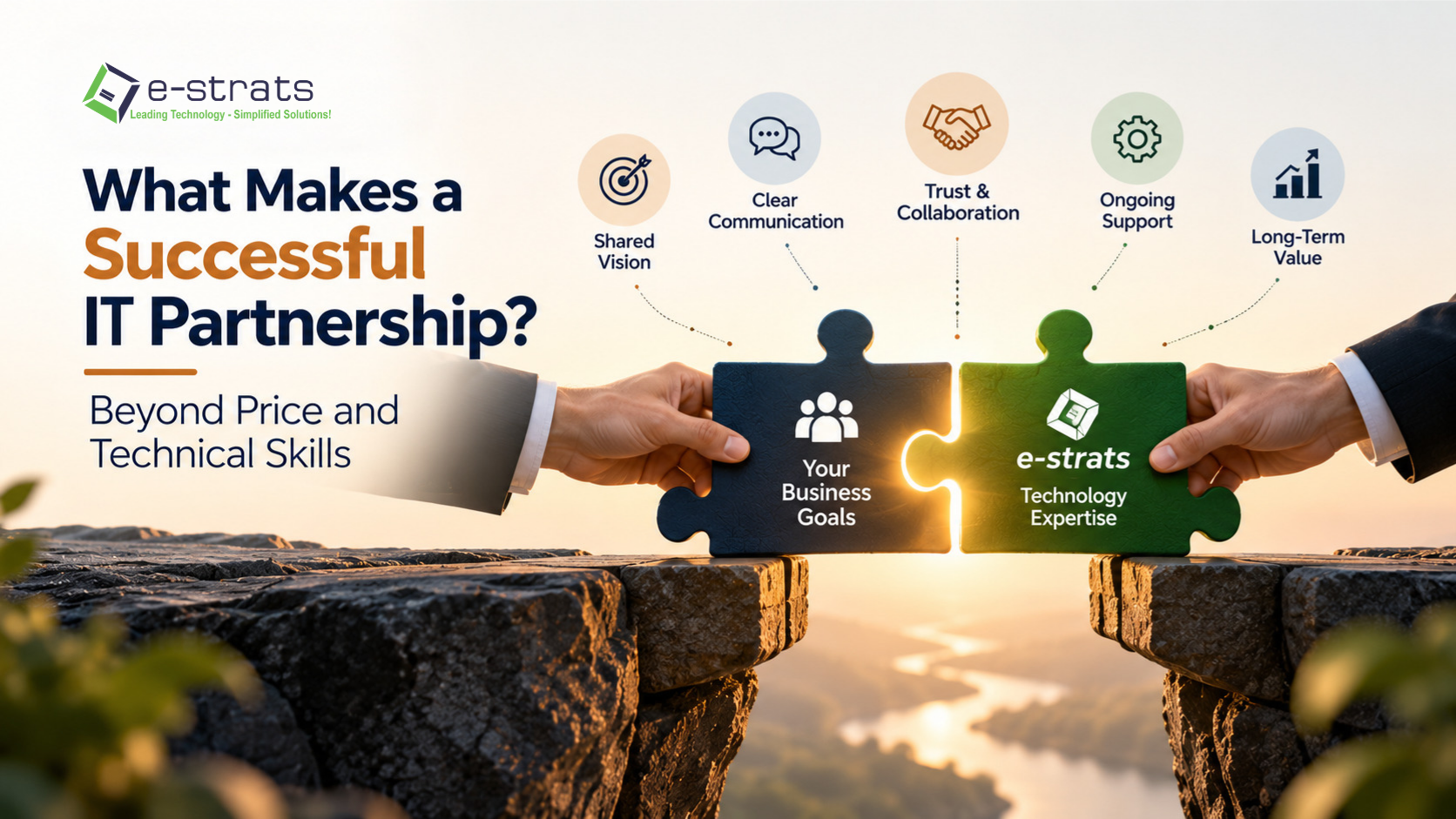
Choosing an IT company is an important business decision. Whether an organization needs custom software, system integration, cloud solutions, AI capabilities or ongoing technical support, the partner it selects can influence operational efficiency, customer experience and long-term growth.
Yet many businesses begin the selection process by comparing quotations, reviewing technology stacks and assessing developers’ technical skills. While these factors matter, they do not tell the whole story. A technically capable provider can still be the wrong partner if it misunderstands business objectives, communicates poorly, fails to manage risks or delivers software that does not solve the underlying problem.
A successful IT partnership combines technical expertise with shared business goals, transparent communication, clear accountability, security and a commitment to measurable outcomes. Instead of focusing exclusively on the cost of a project, businesses should evaluate how effectively a technology partner can help them solve problems, adapt to change and create sustainable value.
This distinction is increasingly important as companies connect more of their operations to software, cloud platforms, data and AI. Technology decisions rarely exist in isolation. They affect employees, customers, workflows and future investment decisions.
This guide explains seven factors that help businesses choose the right IT partner, evaluate potential providers and build a relationship that delivers value beyond the initial project.
What Is a Successful IT Partnership?
A successful IT partnership is a collaborative relationship in which a business and its technology provider work toward agreed objectives, share information, manage responsibilities and measure progress against meaningful outcomes.
Unlike a transactional vendor relationship, which may focus primarily on delivering a specified product or completing a defined task, a strong IT partnership also considers the wider business context. The provider seeks to understand the organization’s challenges, existing systems, operational constraints and future priorities before recommending an approach.
For example, a company experiencing delays in order processing may initially request a new application. A good technology partner will investigate whether the real problem involves disconnected systems, duplicate data entry, unclear approval procedures or limitations in the existing software. The right solution may involve integration or process improvement rather than building an entirely new platform.
The objective is not to purchase more technology. It is to use technology effectively to achieve business goals.
A successful IT partnership should therefore demonstrate four characteristics: alignment between technology and business strategy, reliable execution, open collaboration and measurable value over time.
7 Factors That Make an IT Partnership Successful
1. Shared Business Goals and a Clear Understanding of Requirements
The foundation of a successful IT partnership is a shared understanding of what the business wants to achieve.
Before recommending technologies or estimating project costs, an IT partner should understand the business problem, who is affected by it, what the current process looks like and what success would mean. This discovery process helps prevent organizations from investing in solutions that meet a technical specification but fail to address the actual need.
Consider a business that wants to improve customer service. Its initial request might be for an AI chatbot. However, further investigation could reveal that customers struggle to obtain accurate information because product data is spread across several systems. Implementing a chatbot without addressing the information problem may simply automate an unsatisfactory experience.
A partner focused on business outcomes will help define the problem, identify dependencies and establish realistic objectives before implementation begins.
Businesses should agree on measurable success criteria wherever possible. These might include shorter processing times, fewer manual errors, improved system availability, faster customer responses or better visibility into operations.
What to look for: A partner that asks meaningful business questions, challenges assumptions constructively and connects technical recommendations to specific operational objectives.
2. Transparent Communication and Collaboration
Even well-planned technology projects can encounter changing requirements, integration problems, resource constraints or unexpected technical issues. The way these situations are communicated often determines whether the partnership remains productive.
A reliable IT partner communicates progress clearly, raises risks early, explains trade-offs and gives stakeholders enough information to make informed decisions. Business teams should not have to guess whether a milestone is on track or discover significant problems shortly before a deadline.
Effective collaboration also requires agreed communication channels, meeting schedules, decision-making responsibilities and escalation procedures. These arrangements are particularly important when internal teams and external developers work across different time zones.
Transparency does not mean that every technical detail must be explained to every stakeholder. It means that information is communicated at the appropriate level, with clear implications for cost, scope, risk and business outcomes.
What to look for: Regular progress updates, documented decisions, accessible project leadership and an honest approach to delays, risks and changing requirements.
3. Technical Expertise That Fits the Business Problem
Technical expertise remains essential, but the most useful skills are those that fit the organization’s actual requirements.
A business developing a cloud-based application may need expertise in scalable architecture, cybersecurity, cloud infrastructure and performance optimization. An organization integrating legacy systems may require API development, data migration, application modernization and experience working with existing enterprise software.
The right partner should be able to explain why a particular architecture, platform or development approach is appropriate. It should also discuss the disadvantages, ongoing costs and limitations of the recommended solution.
Businesses should avoid choosing a provider solely because it promotes a fashionable technology or offers the lowest development estimate. A technically impressive solution can still be unnecessarily complex, expensive to maintain or poorly suited to existing operations.
Technical quality should include maintainability, testing, documentation, performance, reliability and security—not merely whether the application works during a demonstration.
What to look for: Relevant project experience, sound architectural reasoning, a practical approach to integration and a willingness to explain technical decisions in business terms.
4. Accountability, Ownership and Predictable Delivery
A strong IT partnership requires clear ownership. Both parties should understand their responsibilities, who makes decisions, how changes are approved and how delivery progress will be measured.
Without this clarity, tasks can fall between teams, dependencies may remain unresolved and disagreements can emerge over what was included in the original scope.
A well-managed engagement establishes milestones, deliverables, acceptance criteria, responsibilities and procedures for handling changes. It also identifies dependencies such as access to business data, internal approvals, third-party services and stakeholder availability.
Accountability extends beyond the launch date. Businesses need to know who will handle defects, maintenance, performance issues and changes after deployment. The agreement should explain support arrangements, service expectations and any applicable response times.
The goal is not to eliminate every uncertainty. It is to make responsibilities visible and provide a structured way to address problems when they arise.
What to look for: Clear ownership, documented deliverables, realistic milestones, defined acceptance criteria and an agreed plan for post-launch support.
5. Security, Data Protection and Risk Management
Security should be part of the IT partnership from the beginning, not an issue addressed only before launch.
Technology providers may need access to business applications, customer records, financial information, employee data or confidential intellectual property. The partnership should therefore establish how information is accessed, stored, transmitted, protected and eventually returned or deleted.
Relevant considerations include access controls, authentication, encryption, secure development practices, backup and recovery procedures, vulnerability management, incident response and the security responsibilities of each party.
Businesses should also evaluate contractual and regulatory obligations that apply to their industry and operating locations. The appropriate controls will depend on the sensitivity of the data, the technology involved and the risks associated with the project.
Security responsibilities should be documented rather than assumed. Organizations should understand which controls the provider manages, which remain their responsibility and how incidents will be reported and addressed.
What to look for: A provider that discusses security and data protection proactively, explains its practices clearly and treats risk management as part of the delivery process.
6. Scalability, Flexibility and Long-Term Thinking
Business requirements rarely remain unchanged. Companies expand into new markets, introduce new services, acquire customers, adopt new technologies and modify their operating models.
An IT partner should therefore consider how today’s solution will support tomorrow’s requirements without creating unnecessary complexity or cost.
Scalability may involve application architecture, cloud infrastructure, integration design, data management, performance and the ability to add new capabilities. Flexibility also means recognizing when existing software is sufficient and when customization or modernization is justified.
Long-term thinking does not mean building the largest possible system from the beginning. Overengineering can waste resources just as easily as underplanning can create future limitations. A practical partner balances immediate needs with realistic growth expectations and makes trade-offs explicit.
The relationship should also support knowledge transfer, documentation and continuity. Businesses need to retain an appropriate understanding of their systems rather than becoming unnecessarily dependent on one provider or individual.
What to look for: Solutions that can evolve with the business, sensible architectural decisions, documented systems and a clear approach to future improvements.
7. Measurable Business Value and Continuous Improvement
The success of an IT partnership should be evaluated by what it helps the business achieve, not only by whether a project was delivered on time.
A system can satisfy every technical requirement yet produce limited business value if employees do not adopt it, workflows remain inefficient or the original problem was misunderstood.
Before implementation, the business and its partner should establish a baseline and agree on relevant performance indicators. Depending on the project, these might include processing time, error rates, system availability, customer satisfaction, cost per transaction, employee adoption or revenue-related outcomes.
After launch, both parties should review actual performance against those measures. If the results fall short, they should investigate why and agree on improvements. This may involve user training, workflow changes, additional integration work or adjustments to the solution.
Continuous improvement also creates opportunities to identify new needs as the business evolves. The partnership becomes more valuable when insights from one project inform future decisions.
What to look for: Clear success measures, post-launch reviews, evidence-based recommendations and a willingness to improve the solution as business needs change.
IT Partnership: What to Evaluate Before Signing a Contract
Comparing potential technology partners becomes easier when businesses use consistent criteria instead of relying on price or presentations alone.
| Evaluation area | Questions to ask | Evidence to request |
|---|---|---|
| Business alignment | Does the provider understand the problem and intended outcomes? | Discovery findings, proposed objectives and scope |
| Communication | How will progress, risks and decisions be communicated? | Reporting plan, meeting cadence and escalation process |
| Technical capability | Has the provider handled comparable requirements? | Relevant case studies, architecture rationale and references |
| Accountability | Who owns delivery, decisions and acceptance? | Milestones, responsibilities and acceptance criteria |
| Security | How will data, access and risks be managed? | Security documentation, contractual controls and incident procedures |
| Scalability | Can the solution adapt to expected business changes? | Architecture plan, integration approach and maintenance strategy |
| Business value | How will success be measured after delivery? | Baseline metrics, KPIs and post-launch review plan |
This checklist helps organizations compare proposals on a like-for-like basis. It also reveals gaps that a low quotation or impressive technical presentation might otherwise conceal.
Why the Cheapest IT Provider Is Not Always the Best Value
Price is an important part of any technology decision, but the initial quotation does not necessarily represent the total cost of ownership.
A lower-cost proposal may exclude important requirements, such as data migration, integration testing, documentation, security controls, training or ongoing support. If these needs emerge later, the business may face additional expenses, delays or operational disruption.
A more expensive proposal is not automatically better either. The value depends on the quality of the solution, the provider’s ability to deliver it, the risks involved and the business outcomes achieved.
A useful comparison considers the full lifecycle: discovery, development, implementation, licensing, integration, maintenance, support and future enhancements. Businesses should also consider the cost of downtime, rework and delays when these risks are relevant.
The best IT partnership is not necessarily the cheapest or the most expensive. It is the one that offers a credible approach to solving the right problem at a sustainable total cost.
How to Build a Strong Long-Term IT Partnership
A successful relationship requires effort from both the technology provider and the client. Selecting the right partner is only the beginning.
First, establish shared objectives and realistic expectations. Define the problem, agree on scope and identify the business measures that will determine success. Make sure relevant stakeholders understand their responsibilities and have time to participate.
Second, maintain open communication throughout the engagement. Raise concerns early, document decisions and discuss changes before they affect delivery. When priorities shift, both parties should evaluate the implications for cost, scope, timing and business value.
Third, review the relationship after implementation. Discuss what worked, what needs improvement and whether the solution is producing the expected results. These reviews should lead to practical actions rather than simply reporting project status.
Finally, invest in continuity. Maintain useful documentation, share knowledge with internal teams and agree on support arrangements. A sustainable partnership should strengthen the business’s ability to operate and evolve its technology over time.
For organizations undertaking broader modernization initiatives, it can also help to connect individual technology projects to a wider business roadmap. Our related guide, Build, Buy or Integrate? How to Choose the Right Technology Solution for Your Business, explores how businesses can assess these options before committing to a particular approach.
How e-strats Approaches Technology Partnerships
At e-strats, technology should support business objectives rather than create complexity for its own sake. Effective solutions begin with understanding the organization’s needs, existing systems, operational challenges and future priorities.
Our approach brings together business requirements, technical planning and practical implementation. Depending on the challenge, this may involve custom software development, integration, IT consulting, cloud technologies or AI-powered capabilities.
For businesses that need help evaluating their technology direction, our IT consulting services provide a starting point for discussing requirements and potential approaches. Organizations exploring intelligent customer interactions can also learn more about our AI and Chatbot Development Services.
The right engagement depends on the problem to be solved. Some businesses need a targeted integration; others require a larger application or a longer-term technology roadmap. In each case, the priority should be a practical solution aligned with business goals, with clear expectations and a focus on long-term value.
Conclusion: Choose a Partner Invested in Your Business Outcomes
A successful IT partnership goes beyond price, technical skills and the delivery of a software project. It depends on shared business goals, transparent communication, technical judgment, clear accountability, security, adaptability and measurable results.
Businesses that evaluate these factors are better positioned to choose a provider that understands their needs and can support them as those needs evolve. They can also make more informed comparisons between proposals, identify risks earlier and establish clearer expectations before work begins.
Technology should make the business more capable, not simply add another system to maintain. The right IT partner helps organizations make thoughtful technology decisions, solve operational problems and build a foundation for sustainable growth.
Looking for a technology partner who understands your business goals? Connect with e-strats to discuss your requirements and explore a practical approach to your next technology initiative.
Frequently Asked Questions
What makes a successful IT partnership?
A successful IT partnership combines technical expertise with shared business goals, transparent communication, clear accountability, appropriate security practices and measurable outcomes. Both parties understand their responsibilities and work collaboratively to solve business problems.
How should a business choose an IT services partner?
A business should evaluate a provider’s understanding of its requirements, relevant experience, communication practices, delivery process, security approach, support arrangements and ability to demonstrate business value. Price should be considered alongside total cost, risk and expected outcomes.
Why is communication important in an IT partnership?
Clear communication helps stakeholders understand progress, resolve issues, manage changing requirements and make informed decisions. Regular updates and documented responsibilities also reduce the risk of misunderstandings and unexpected delivery problems.
Should businesses choose an IT partner based on price?
No. Price matters, but businesses should also assess total cost of ownership, delivery quality, security, maintenance, integration requirements and the expected business benefits. The lowest initial quotation may not represent the best long-term value.
How can businesses measure the success of an IT partnership?
Businesses can measure success using project-specific indicators such as delivery against agreed requirements, system reliability, processing time, error rates, employee adoption, support performance and operating costs. The most useful measures are agreed upon before implementation and reviewed after launch.
What is the difference between an IT vendor and a technology partner?
An IT vendor may provide a defined product or service, while a technology partner typically works more collaboratively with the business to understand its goals, advise on options and support ongoing improvements. The distinction depends on how the relationship operates, not simply the title used in a contract.
How long should an IT partnership last?
There is no universal ideal duration. Some engagements are short and project-specific, while others continue through maintenance, modernization and ongoing development. The relationship should last as long as it continues to provide appropriate value, support and expertise for the business.
