
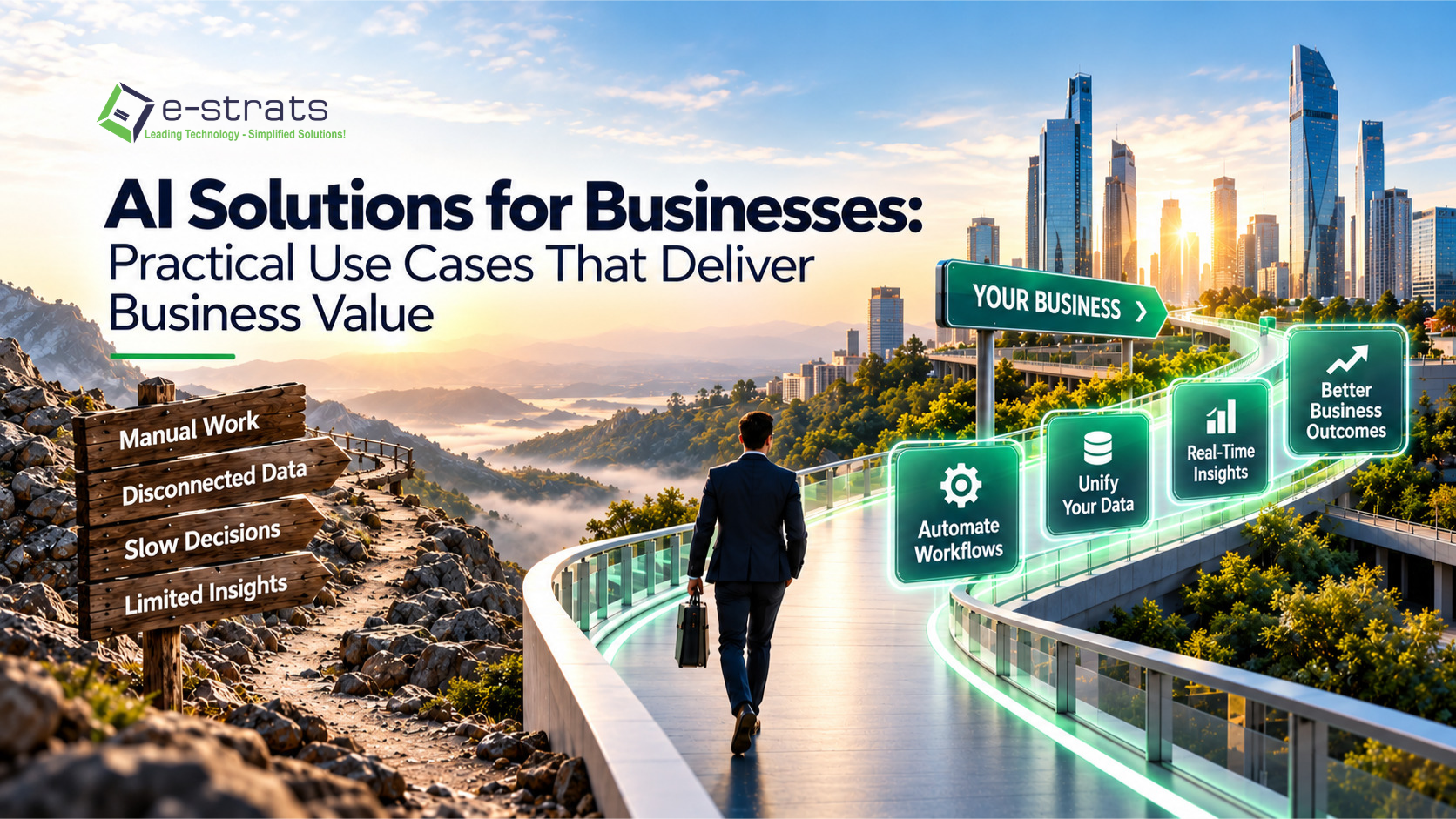
Artificial intelligence is creating new opportunities for businesses to improve productivity, streamline operations, and make better decisions. However, adopting AI technology does not automatically lead to better business outcomes. The real value comes from applying the right AI capabilities to problems that affect everyday operations, customers, costs, and growth.
For business leaders, the important question is not simply how to introduce AI. It is where AI can make a measurable difference.
AI solutions for businesses can help automate complex workflows, extract insights from business data, improve customer interactions, forecast operational needs, and support faster decision-making. The most effective implementations begin with a clearly defined problem, reliable data, and a way to measure success.
This guide explores practical AI business use cases, explains how to identify the right opportunities, and outlines how organizations can implement AI solutions that deliver meaningful business value.
What Does It Mean to Use AI to Solve Business Problems?
Using AI in business means applying artificial intelligence to specific tasks or decisions where capabilities such as language understanding, pattern recognition, prediction, classification, or information extraction can improve an existing process.
For example, a company may use AI to interpret incoming customer requests, identify patterns in service data, extract information from documents, or generate summaries from approved business knowledge. When connected to existing applications and workflows, these capabilities can help employees complete tasks more efficiently and access relevant information more quickly.
AI is not always the best solution to every operational challenge. A predictable approval process may need a straightforward automated workflow, while transferring structured information between applications may require API integration. AI becomes more useful when a task involves unstructured information, ambiguous requests, complex patterns, or decisions that benefit from context.
The goal is to choose technology based on the problem rather than force AI into a process simply because it is available.
6 Practical AI Solutions for Businesses
AI can support many business functions, from customer engagement and internal operations to analytics and strategic planning. The following use cases illustrate where organizations can begin exploring its potential.
1. Automate Complex and Repetitive Workflows
Many employees spend a significant part of their working day processing requests, reviewing documents, updating records, classifying emails, and coordinating tasks between departments.
Traditional automation handles predictable steps effectively. AI can extend these workflows by helping interpret information that does not always follow a standard format.
For example, an AI-enabled workflow could read an incoming purchase request, identify relevant details, classify the request, check whether required information is present, and send it to the appropriate approval process. If the request contains unusual information or falls outside defined rules, the workflow can direct it to an employee for review.
Other potential applications include document classification, service request categorization, contract information extraction, and processing of customer inquiries.
The business benefit is not simply fewer manual steps. A well-designed workflow can reduce repetitive effort, improve consistency, and help employees focus on exceptions that require judgment.
Businesses exploring this area can also review e-strats’ AI chatbot development and AI automation services.
2. Turn Business Data Into Actionable Insights
Organizations collect information through CRM platforms, ERP systems, financial applications, customer interactions, operational databases, and analytics tools. However, having large amounts of data does not necessarily mean employees can use it effectively.
AI can help identify patterns, summarize information, flag unusual results, and support questions about business performance. Predictive analytics can also use historical data to estimate future outcomes, provided that the data and modelling approach are appropriate for the task.
Consider a service business that wants to understand why certain jobs take longer than expected. By analyzing historical work orders, scheduling information, service categories, and completion times, an analytics solution may identify patterns associated with delays. Managers can then investigate the causes and decide whether scheduling, resource allocation, or process changes are needed.
Similarly, AI-assisted analysis can help sales teams identify changes in lead activity, finance teams examine unusual transactions, or operations managers detect shifts in demand.
These outputs should support decision-making rather than replace it. Managers still need to examine assumptions, validate findings, and consider relevant business context.
3. Improve Customer Support and Lead Management
Customers often expect quick responses, accurate information, and consistent communication. At the same time, support and sales teams must manage inquiries across websites, email, messaging platforms, and other channels.
AI-powered chatbots and virtual assistants can answer approved frequently asked questions, collect customer details, classify requests, and direct inquiries to the appropriate team. They can also help sales teams qualify leads by gathering relevant information before a conversation with a salesperson.
For example, a prospective customer visiting a software company’s website could ask about available services, implementation options, or the next steps in arranging a consultation. An AI assistant could retrieve relevant information from an approved knowledge base, ask qualifying questions, and route the inquiry to the sales team.
The same approach can help customer support teams handle routine requests while escalating complaints, sensitive issues, or questions the AI cannot reliably answer.
Successful implementation depends on more than the chatbot itself. Accurate knowledge sources, appropriate access controls, clear escalation procedures, and monitoring are essential to maintaining a useful customer experience.
4. Predict Operational Demand and Identify Risks Earlier
Businesses often need to anticipate demand, allocate resources, manage inventory, schedule employees, or identify equipment that may require attention.
AI and predictive analytics can analyze historical patterns alongside relevant operational data to help estimate future requirements or identify unusual conditions.
A field service company, for instance, may examine historical work orders, asset records, location information, and service history to improve planning. An appropriately designed model could help forecast demand by service category or location, identify recurring sources of delays, or flag assets that warrant inspection.
A retailer might use demand forecasts to support inventory planning, while a logistics company could analyze operational data to identify recurring delivery bottlenecks.
These predictions are not guarantees. Their usefulness depends on data quality, changing operating conditions, model performance, and how predictions are incorporated into real decisions.
The objective is to give decision-makers earlier and more relevant signals so they can investigate potential problems and respond proactively.
5. Make Business Knowledge Easier to Find
Important business information is often spread across policies, process documents, product manuals, project records, internal knowledge bases, and support documentation. Employees may waste time searching for the correct document or asking colleagues to repeat information that already exists.
AI-powered knowledge assistants can help employees find and summarize relevant information using natural-language questions. When designed to retrieve answers from approved sources, these tools can make internal knowledge easier to access without requiring every employee to understand how the information is organized.
For example, a service technician could ask how to handle a particular maintenance procedure, or a new employee could search for an internal policy using everyday language.
The assistant should identify the source of its answer where possible, respect the employee’s existing permissions, and communicate when information is missing or uncertain. It should not expose confidential documents simply because it can locate them.
For organizations with large document collections, the challenge is often as much about knowledge management, security, and data access as it is about the AI model.
6. Connect Disconnected Systems and Improve Decision-Making
A business may have effective individual applications yet still struggle with fragmented information. Sales information may live in a CRM, financial records in an accounting platform, and operational data in a separate application.
AI cannot reliably solve this problem merely by being added on top. Businesses also need to establish how data is accessed, validated, governed, and shared between systems.
Combining AI with systems integration can help teams bring relevant information together and use it more effectively. For instance, an executive dashboard could combine sales activity, operational performance, and financial indicators. An AI assistant might summarize significant changes and help identify questions for further investigation.
The underlying integrations remain critical. Data definitions must be consistent, access permissions must be enforced, and the organization must understand which system is authoritative for each type of information.
This is where AI, data engineering, API development, and enterprise architecture can work together. The result is a stronger foundation for decisions rather than another isolated technology tool.
How to Choose the Right AI Use Case
The best starting point is usually a business problem that is important, recurring, and sufficiently well understood to measure before and after implementation.
Begin by examining where employees spend time on repetitive work, where decisions lack timely information, where customers experience delays, or where important data is difficult to access. Next, determine whether AI is actually needed or whether a simpler process improvement would solve the problem.
The table below offers a practical way to connect common challenges with possible approaches.
| Business challenge | Potential AI approach | What to measure |
|---|---|---|
| Documents require manual review | Information extraction and classification | Processing time and extraction accuracy |
| Customer inquiries take too long to route | AI-assisted classification and workflow automation | First-response time and routing accuracy |
| Managers struggle to interpret large datasets | Predictive analytics and AI-assisted summaries | Forecast accuracy and time to insight |
| Employees cannot find internal information | Search and retrieval from approved knowledge sources | Search time and answer quality |
| Operations face recurring delays | Pattern analysis and predictive signals | Delays, utilization, and schedule accuracy |
| Business applications contain fragmented information | Systems integration combined with AI-assisted analysis | Data consistency and decision-making time |
These are starting points, not universal recommendations. The right solution depends on the specific process, available data, operational constraints, and business priorities.
How to Implement AI Successfully in Your Business
A successful AI initiative requires more than choosing a model or purchasing software. It needs a clear purpose, suitable technical foundations, defined responsibilities, and a plan for evaluating outcomes.
Step 1: Define the Business Problem
Describe the issue in operational terms. Instead of setting a goal such as “introduce AI into customer service,” define the underlying problem—for example, reducing the time required to classify incoming support requests or helping customers find answers to common questions.
A specific problem makes it easier to determine what the system needs to do and whether AI is an appropriate approach.
Step 2: Establish a Baseline
Before implementation, record how the process currently performs. Relevant measures could include average processing time, manual hours, error rates, cost per request, customer response time, or the number of cases requiring rework.
A baseline provides a basis for comparison. Without it, an organization may struggle to determine whether the solution has produced meaningful improvement.
Step 3: Assess Data and System Readiness
Review the information the solution will need, where it resides, who can access it, and whether it is reliable enough for the intended purpose. Determine whether the solution must connect to existing CRM, ERP, customer service, financial, or operational systems.
Data quality, integration complexity, privacy requirements, and system permissions can materially affect the design and cost of implementation.
Step 4: Choose the Right Technical Approach
Not every task requires a custom AI model. Some can be addressed with existing AI services, while others may need retrieval from a business knowledge base, predictive modelling, custom application development, or integration with an established workflow platform.
The decision should reflect the problem’s complexity, expected usage, performance requirements, available infrastructure, and long-term maintenance needs.
Step 5: Pilot, Test, and Review
Start with a limited use case and test it against realistic scenarios, including unusual requests and failure cases. Evaluate the accuracy of outputs, the reliability of integrations, user experience, and the handling of sensitive information.
Where errors could have significant consequences, require human approval before the system takes action. Define clear escalation routes for uncertainty, missing information, and unexpected results.
Step 6: Integrate, Monitor, and Improve
An AI tool creates lasting value when it fits the way employees and systems already work. Incorporate it into the relevant process, train users, and clarify who is responsible for reviewing results and managing exceptions.
After launch, monitor system performance and business outcomes. Models, data, workflows, and organizational needs can change, so ongoing evaluation and maintenance should be part of the implementation plan.
How to Measure the Business Value of AI
AI performance should be evaluated through business outcomes, not merely the number of people using a tool or the number of outputs it generates.
The right metrics depend on the use case. A document-processing solution may be judged by processing time and extraction accuracy. A customer service assistant may be evaluated through response times, successful resolution rates, and customer satisfaction. A forecasting model may be assessed through forecast error and the operational decisions that follow from its predictions.
Financial evaluation should also include the costs of development, integration, licenses, infrastructure, monitoring, training, and ongoing support.
A useful way to evaluate an AI pilot is to compare its performance with the baseline established before implementation. Determine which improvements can be attributed to the solution, account for new costs, and distinguish time saved from cash savings actually realized.
This approach helps businesses make informed decisions about whether to refine, expand, or discontinue a particular use case.
Common AI Implementation Mistakes to Avoid
One common mistake is adopting AI without defining the business problem. A technically impressive solution may have limited value if it does not improve a meaningful part of the operation.
Another is overlooking data quality and integration. AI outputs can become unreliable when information is incomplete, inconsistent, outdated, or inaccessible to the relevant systems. Organizations should also avoid allowing AI-generated content or recommendations to pass into important workflows without appropriate validation.
Security and governance must be considered from the beginning. Businesses should establish access controls, protect sensitive information, document responsibilities, test for relevant risks, and define when human review is required. The NIST AI Risk Management Framework and its Generative AI Profile provide resources for organizations seeking a structured approach to managing AI-related risks.
Finally, organizations should avoid treating deployment as the finish line. Adoption, monitoring, feedback, and maintenance all affect whether the solution continues to deliver value.
How e-strats Helps Businesses Apply AI to Real Problems
At e-strats, we help organizations evaluate technology opportunities and develop solutions aligned with their operational needs and business objectives.
Our services include AI-powered applications, intelligent automation, chatbot development, predictive analytics, system integration, and strategic IT consulting. Depending on the challenge, a solution may involve integrating AI into an existing application, developing a custom system, connecting business data, or redesigning a workflow before introducing new technology.
Explore our AI chatbot development and AI automation services to learn about potential applications for customer interactions and business workflows. For broader requirements involving technology planning, data strategy, application integration, or digital transformation, visit our IT consulting and system integration services.
The objective is to identify where technology can make a meaningful difference and design a solution that can be evaluated, maintained, and improved over time.
Conclusion: Start With a Business Problem, Not the Technology
AI can help businesses work more efficiently, understand their data, improve customer interactions, and make better-informed decisions. However, successful implementation begins with a clear business need rather than a desire to adopt the latest technology.
Organizations should identify a meaningful problem, establish a baseline, assess data and integration requirements, select an appropriate solution, and measure the results. Security, governance, and human oversight should be built into the process from the start.
With a practical strategy and a suitable technical foundation, AI can become part of a broader effort to improve business performance—not just another tool added to the technology stack.
Ready to explore practical AI opportunities for your business? Contact e-strats to discuss your challenges and identify technology solutions aligned with your goals.
Visit www.estratcom.com to learn more about our AI solutions, automation, and IT consulting services.
Frequently Asked Questions About AI Solutions for Businesses
What business problems can AI solve?
AI can help businesses classify and process information, automate complex workflows, analyze data, forecast demand, support customer service, and make internal knowledge easier to find. Its suitability depends on the problem, the available data, and the consequences of an incorrect output.
How can a business start using AI?
Start by identifying a specific operational problem, measuring current performance, and assessing the data and systems involved. Select a limited use case, test it under realistic conditions, and compare the results against the original baseline before expanding the solution.
Does every business need a custom AI solution?
No. Some businesses can use existing AI services or software capabilities. Custom development may be appropriate when requirements, data, integrations, security, or workflow needs cannot be met effectively by available tools.
How can businesses measure AI ROI?
Businesses can compare measurable benefits with implementation and ongoing operating costs. Relevant measures include time saved, processing costs, accuracy, error rates, response times, customer satisfaction, and operational performance. Results should be assessed against a baseline, with assumptions documented clearly.
What are the main risks of using AI in business?
Potential risks include inaccurate outputs, privacy and security issues, biased results, unauthorized data access, and excessive reliance on automated decisions. Organizations should implement appropriate access controls, testing, monitoring, human review, and clear accountability.
Can AI work with existing CRM and ERP systems?
Yes. AI can be integrated with existing CRM, ERP, and other business applications when the systems provide suitable integration methods and the organization can establish appropriate data access and security controls. The technical approach depends on the applications, data architecture, and workflow requirements.
