
Digital transformation is often described as a technology initiative.
Organizations invest in cloud platforms, enterprise applications, AI, automation, data platforms, ERP systems, CRM solutions, and modern digital experiences expecting them to improve efficiency, reduce costs, strengthen decision-making, and create new opportunities.
But there is a problem.
Many digital transformation projects fail before the technology is even implemented.
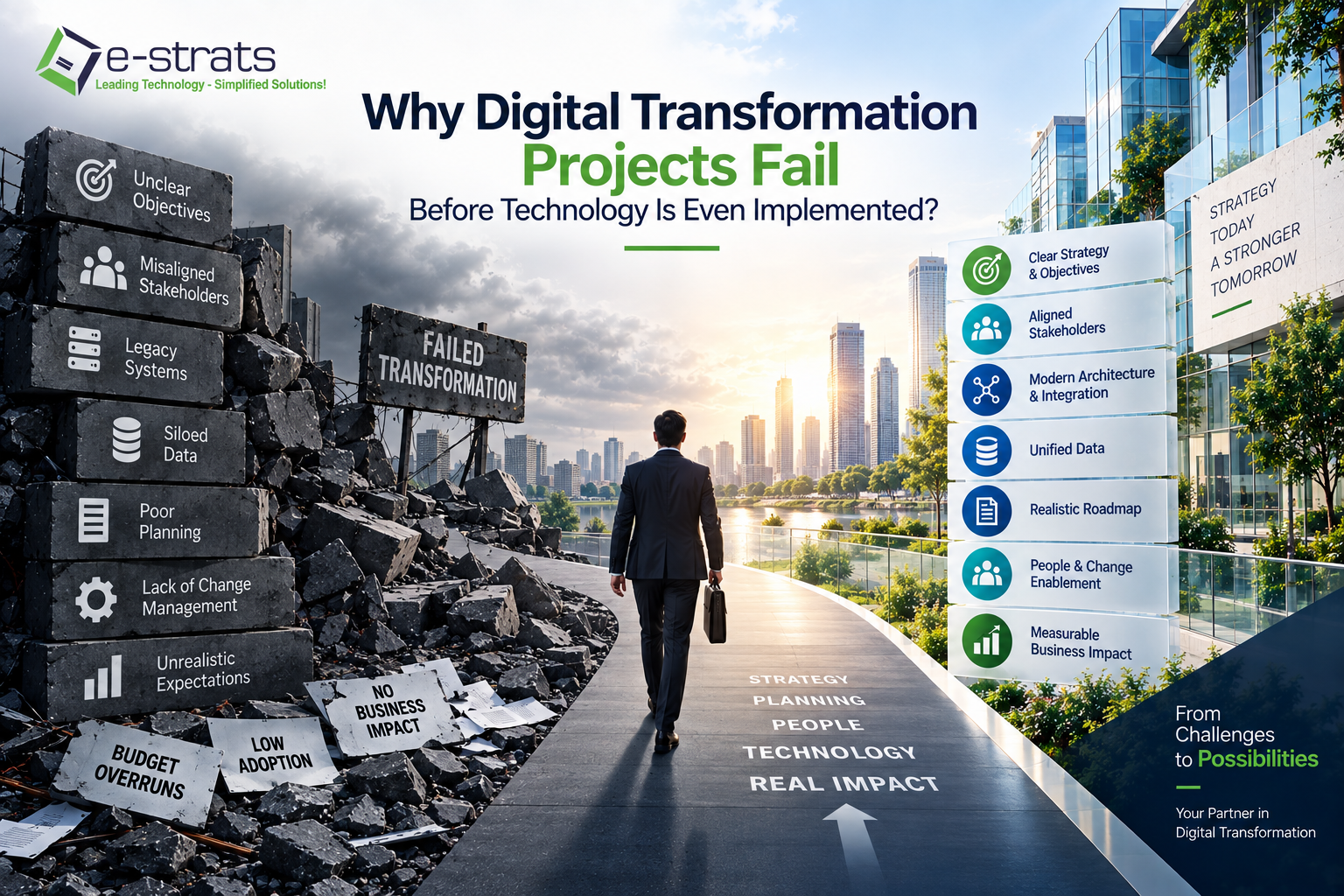
The root cause is often not the software, cloud platform, AI model, or development team. It is what happens before implementation begins: unclear objectives, inadequate planning, fragmented systems, poor stakeholder alignment, unrealistic expectations, weak data foundations, and the absence of a practical technology roadmap.
Digital transformation is not simply about implementing new technology. It is about changing how an organization operates, makes decisions, serves customers, manages information, and creates value.
That is why successful transformation starts with strategy before implementation.
In this article, we explore the most common reasons digital transformation projects fail and what organizations can do differently.
What Does Digital Transformation Really Mean?
Digital transformation is more than moving paper-based processes online or replacing an old application with a newer one.
It involves using technology, data, automation, and redesigned processes to fundamentally improve how an organization operates and delivers value.
A successful transformation may involve:
- Modernizing legacy systems
- Integrating disconnected applications
- Moving workloads to the cloud
- Automating manual processes
- Improving data management
- Introducing AI and analytics
- Redesigning customer or employee experiences
- Strengthening cybersecurity
- Creating real-time business intelligence
- Improving operational scalability
However, technology is only one component.
A transformation program also requires business strategy, process redesign, people, governance, data, architecture, and change management.
This is where strategic IT consulting becomes important.
Before organizations decide what technology to implement, they need to understand what problem they are actually trying to solve.
1. No Clear Business Objective
One of the most common digital transformation challenges is starting with technology rather than business outcomes.
An organization may say:
“We need a new ERP.”
Or:
“We need to move everything to the cloud.”
Or:
“We need to implement AI.”
But these are technology initiatives, not business objectives.
The better questions are:
- What business problem are we solving?
- Which process is creating the most friction?
- Where are costs increasing?
- Where are customers experiencing delays?
- Which decisions lack reliable data?
- What prevents the organization from scaling?
- Which risks need to be reduced?
- What measurable outcome should the transformation produce?
For example, instead of defining the objective as “implement a new CRM,” an organization could define the goal as:
“Create a unified customer data environment that reduces response times, improves sales visibility, and enables more consistent customer engagement.”
The technology becomes the means—not the objective.
The lesson
Start with business outcomes. Then define the technology required to achieve them.
2. Technology Is Selected Before the Problem Is Fully Understood
Another reason digital transformation projects fail is premature technology selection.
Organizations sometimes choose a platform because it is popular, because a competitor uses it, or because a vendor presents an attractive demonstration.
But a product demo rarely tells the full story.
Before selecting technology, organizations should conduct a current-state assessment covering:
- Existing applications
- Business processes
- Data flows
- Infrastructure
- Integrations
- Security
- Technical debt
- User requirements
- Compliance requirements
- Operational dependencies
An IT architecture assessment can reveal that the problem is not necessarily a missing application.
It may be:
- duplicated systems
- disconnected databases
- manual workflows
- poor APIs
- outdated architecture
- inconsistent data
- inefficient processes
Without understanding the current environment, a new system can simply add another layer of complexity.
3. Legacy Systems Are Treated as an Afterthought
Legacy systems are one of the biggest challenges in enterprise digital transformation.
Organizations often want modern digital experiences while continuing to depend on older applications that run critical business processes.
The challenge is not simply:
“How do we replace the old system?”
The better question is:
“How do we modernize without disrupting the business?”
Depending on the situation, organizations may consider:
- Rehosting
- Replatforming
- Refactoring
- Rebuilding
- Replacing
- Integrating
- Gradual modernization
There is no universal answer.
A strategic modernization approach evaluates the business importance, technical condition, integration requirements, security risks, cost, and future scalability of each system.
This is why legacy systems modernization should be treated as a strategic decision rather than a simple software replacement exercise.
4. Systems Operate in Silos
Imagine an organization where:
- The CRM has customer information.
- The ERP has financial information.
- HR has employee information.
- Operations has workflow information.
- The analytics platform has reporting data.
But none of these systems communicate effectively.
The organization may have plenty of technology but still lack visibility.
This is digital fragmentation.
Systems integration is therefore a critical part of modern digital transformation.
An integrated architecture can allow information to move securely between systems through APIs, integration platforms, shared data models, and well-defined interfaces.
The objective is not necessarily to replace every existing application.
Sometimes the smarter strategy is to connect and modernize what already works.
5. Stakeholders Are Not Aligned
Digital transformation affects almost every part of an organization.
Executives care about business value.
Finance cares about investment and return.
IT cares about architecture, security, scalability, and maintainability.
Operations cares about productivity.
Employees care about usability.
Customers care about experience.
If these groups have different expectations, transformation can quickly lose direction.
A strong transformation strategy establishes:
- Clear objectives
- Executive sponsorship
- Defined ownership
- Stakeholder responsibilities
- Decision-making processes
- Success metrics
- Communication mechanisms
Transformation should not be an IT project owned exclusively by IT.
Technology enables the transformation, but the business must own the outcomes.
6. There Is No Practical Technology Roadmap
A transformation program can have a compelling vision and still fail because the organization does not know how to get there.
A technology roadmap translates strategy into an actionable sequence.
A practical roadmap should answer:
Where are we today?
Where do we need to go?
What should we change first?
What can wait?
What dependencies exist?
What risks need to be managed?
How will we measure progress?
A useful transformation roadmap often follows a phased approach:
Phase 1 — Assess
Understand the current technology and business environment.
Phase 2 — Prioritize
Identify initiatives based on business value, complexity, risk, and urgency.
Phase 3 — Architect
Design the future-state technology environment.
Phase 4 — Modernize
Upgrade applications, infrastructure, data, and processes in manageable stages.
Phase 5 — Integrate
Connect systems and establish reliable data flows.
Phase 6 — Adopt
Train teams and embed new ways of working.
Phase 7 — Measure
Track business outcomes and continuously improve.
This approach is much more sustainable than attempting to transform everything simultaneously.
7. Data Is Treated as an Afterthought
Digital transformation depends on data.
Yet many organizations begin technology projects without first understanding the condition of their data.
Common problems include:
- Duplicate records
- Inconsistent formats
- Missing information
- Multiple sources of truth
- Poor data ownership
- Legacy databases
- Manual data entry
- Limited governance
These issues become particularly important when organizations introduce AI, analytics, automation, or real-time reporting.
AI cannot compensate for an organization-wide data strategy that does not exist.
Before implementing advanced technologies, organizations should establish:
- Data ownership
- Data quality standards
- Integration architecture
- Security controls
- Governance processes
- Master data principles
- Reporting requirements
Modern applications require modern data foundations.
8. Change Management Is Ignored
Even the best technology can fail if people do not adopt it.
A new enterprise platform may provide powerful capabilities, but employees may continue using spreadsheets, manual processes, or unofficial workarounds.
Why?
Because transformation changes behavior.
Successful digital transformation therefore requires more than technical deployment.
Organizations need:
- User involvement
- Training
- Communication
- Process documentation
- Leadership support
- Change champions
- Feedback mechanisms
- Continuous improvement
This is why change management should be part of the transformation strategy from the beginning—not added after implementation.
9. Success Is Not Clearly Defined
Another common reason digital transformation projects fail is that organizations measure implementation rather than impact.
A project may be considered successful because:
- The software went live.
- The migration was completed.
- The platform was delivered.
- The project stayed within budget.
But these measures don’t necessarily demonstrate transformation.
The more important questions are:
- Did operational efficiency improve?
- Did processing time decrease?
- Did customer experience improve?
- Did employees become more productive?
- Did decision-making become faster?
- Did data visibility improve?
- Did operating costs decrease?
- Did the organization become easier to scale?
The technology implementation is a milestone.
Business impact is the real measure of transformation.
What is the Better Digital Transformation Approach?
Organizations can reduce transformation risk by following a structured process:
1. Understand the Business
Start with strategic objectives and measurable business problems.
2. Assess the Current Technology Landscape
Evaluate applications, infrastructure, data, integrations, security, and technical debt.
3. Identify the Gaps
Determine where current capabilities fall short of business requirements.
4. Define the Future State
Design the target operating model, architecture, data environment, and technology ecosystem.
5. Build the Roadmap
Prioritize initiatives based on business value, risk, cost, dependencies, and organizational readiness.
6. Modernize and Integrate
Implement changes in manageable phases while protecting business continuity.
7. Enable Adoption
Prepare people and processes for the new environment.
8. Measure Outcomes
Track business performance, technology performance, adoption, and return on investment.
This turns digital transformation from a collection of technology projects into a strategic business program.
What is the Role of Strategic IT Consulting?
Organizations don’t always need another software vendor.
Sometimes they need an experienced technology partner who can look across the entire environment and answer:
What should we change?
Why should we change it?
What should we modernize first?
How should our systems connect?
What technology should we invest in?
How do we reduce transformation risk?
How do we turn technology investment into measurable business value?
This is where strategic IT consulting can provide value.
At e-strats, our consulting approach combines IT strategy, digital transformation advisory, systems integration, AI and data strategy, and systems modernization to help organizations move from technology challenges to practical transformation roadmaps.
Our approach is designed to connect strategy with execution—from assessing existing environments and identifying opportunities to designing modern architectures and supporting implementation.
Digital Transformation Should Start Before Implementation
The biggest mistake organizations can make is treating digital transformation as a software procurement exercise.
Transformation begins much earlier.
It begins with understanding the business.
It continues with assessing technology, processes, data, people, and organizational readiness.
And it succeeds when technology is deliberately aligned with measurable business outcomes.
The question isn’t simply, “What technology should we implement?”
The better question is:
“What should our organization become—and what technology foundation will help us get there?”
That is the starting point for meaningful digital transformation.
Ready to Build a More Strategic Technology Roadmap?
Whether your organization is dealing with legacy systems, disconnected applications, cloud adoption, data challenges, or a broader digital transformation initiative, the first step is understanding your current technology landscape and defining the right path forward.
e-strats helps organizations turn technology complexity into practical, scalable digital transformation strategies.
Explore e-strats IT Consulting & Digital Transformation Services. Talk to our consulting team about your transformation goal.
Final Takeaway
Digital transformation doesn’t fail only because technology fails.
It can fail because organizations begin with the technology before they have defined the strategy.
Assess first. Align stakeholders. Modernize strategically. Integrate intelligently. Measure business outcomes.
That’s how technology becomes a business advantage—not another layer of complexity.
