
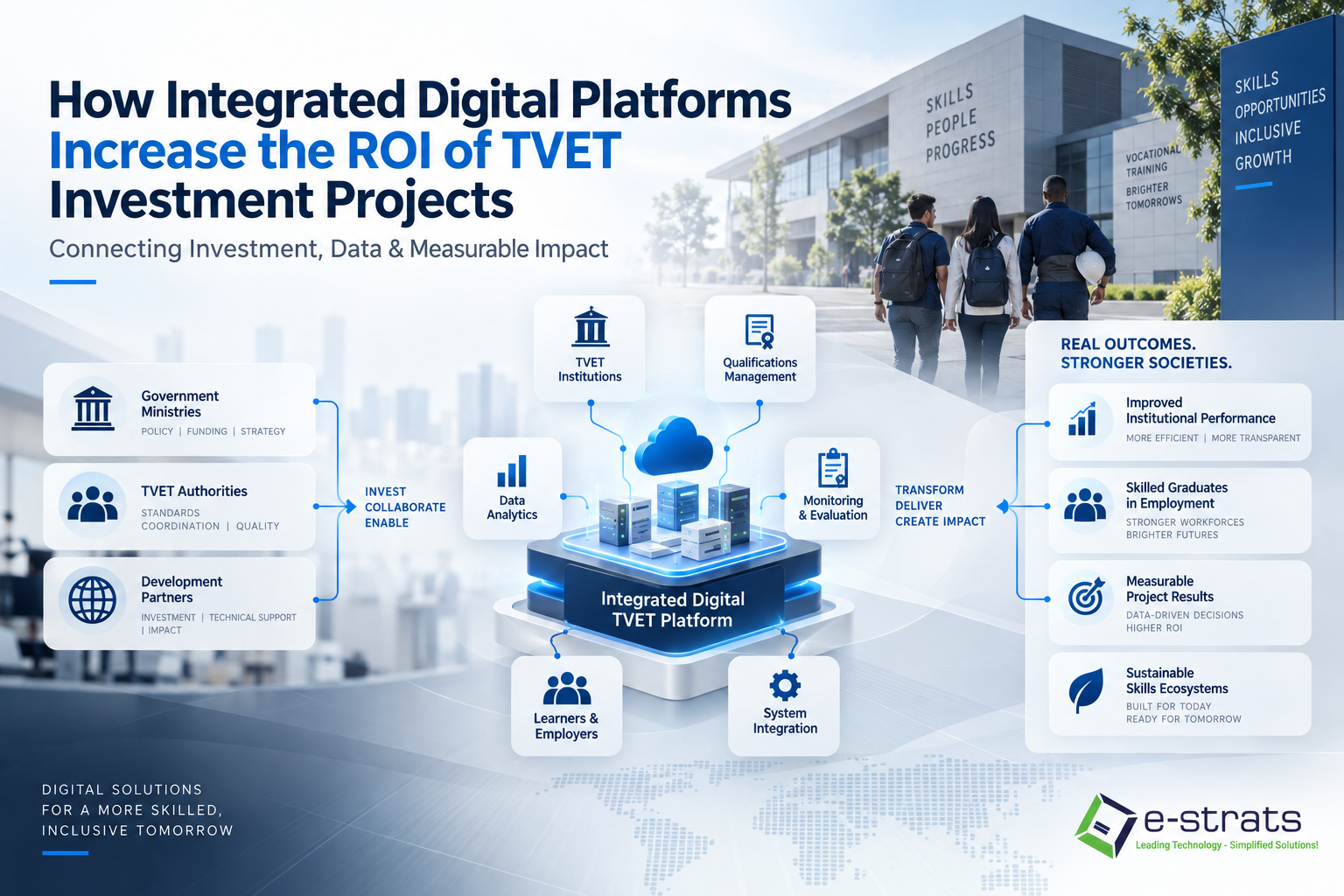
TVET investment projects play an important role in developing skilled workforces, strengthening vocational education and supporting economic growth. However, the ROI of TVET Investment Projects depends on more than the funding allocated, institutions established or learners trained. It also depends on how effectively investments translate into measurable outcomes, sustainable systems and employment opportunities.
Governments, TVET authorities and development partners invest in training infrastructure, curriculum development, institutional capacity building and workforce development. Yet when project activities are managed through disconnected systems, it can become difficult to track progress, measure results and sustain improvements after funding ends.
Integrated digital platforms offer a practical way to connect these activities, improve project visibility and strengthen the long-term value of TVET investments.
For African and European governments, development agencies and TVET authorities, digital transformation is increasingly relevant to the question of how to achieve greater impact from every investment in skills development.
What Is the ROI of TVET Investment Projects?
The return on investment (ROI) of a TVET project refers to the value generated in relation to the resources invested.
In vocational education and skills development, this value extends beyond financial returns. It can include improved institutional performance, stronger workforce competencies, better employment outcomes and more effective use of public and donor funding.
Key areas for assessing TVET investment returns include:
- Learner enrolment, completion and certification rates
- Graduate employment and skills utilisation
- Employer satisfaction and industry engagement
- Institutional efficiency and service delivery
- Quality assurance and accreditation outcomes
- Project implementation and budget performance
- Long-term sustainability of digital and institutional improvements
Measuring these outcomes requires reliable information from different institutions, programmes and stakeholders.
This is where TVET digital transformation can make a significant difference.
Why Disconnected Systems Reduce TVET Project Efficiency?
Many TVET investment projects involve multiple stakeholders, including ministries, qualification authorities, training institutions, employers and development partners.
When each organisation maintains separate records and reporting processes, several challenges can emerge.
1. Fragmented Project Data
Learner records, institutional information, qualifications, assessments and employment outcomes may be stored in different systems.
This fragmentation makes it difficult for decision-makers to develop a complete picture of project performance.
2. Manual Monitoring and Reporting
Collecting information from multiple institutions through spreadsheets and manual reports can increase administrative workloads and delay reporting.
It can also make it harder to identify inconsistencies and maintain reliable data.
3. Limited Visibility Into Project Outcomes
Without connected data, project managers may know how many learners were trained but have limited information about certification, employment or the relevance of acquired skills.
4. Duplication of Technology Investments
Different project components may introduce separate software platforms that perform overlapping functions.
This can increase maintenance requirements, complicate data exchange and create additional costs after the project ends.
5. Weak Institutional Continuity
When digital systems are designed around individual projects rather than long-term institutional needs, their continued operation may become difficult once donor funding concludes.
These challenges demonstrate why integrated digital platforms for TVET should be considered part of the project’s overall investment strategy.
How Integrated Digital Platforms Improve the ROI of TVET Investment Projects?
An integrated digital platform connects relevant TVET processes, information and stakeholders within a coordinated digital ecosystem.
Rather than managing every activity through an independent application, institutions can share information across connected modules and use consistent data for operational management and decision-making.
1. Improve Operational Efficiency
A connected TVET management information system can reduce repetitive data entry, streamline administrative processes and improve access to institutional information.
For example, learner registration, programme management, assessment records and certification can be connected within a common workflow.
This helps institutions reduce administrative duplication and focus more resources on training quality and learner support.
2. Strengthen Monitoring and Evaluation
Effective TVET monitoring and evaluation requires accurate, timely and consistent information.
Integrated platforms can help authorities collect and analyse information about project activities, institutional performance and learner outcomes.
Dashboards can present indicators such as enrolment, completion, certification and employment outcomes, allowing project managers to monitor progress against defined objectives.
This supports more informed decisions and more transparent project reporting.
3. Improve Data-Driven Decision-Making
TVET authorities need reliable information to understand which programmes are delivering relevant skills and where improvements are required.
TVET data analytics can help identify patterns in learner performance, institutional capacity, qualification demand and employment outcomes.
When combined with labour-market information, these insights can support better decisions about programme development, resource allocation and workforce priorities.
4. Connect Training With Industry Needs
The value of TVET investment depends partly on whether training programmes develop competencies relevant to employers.
Integrated digital platforms can connect qualification management, occupational standards, training programmes, assessment and employer engagement.
This can help authorities identify gaps between training provision and labour-market requirements.
For example, information about graduate employment and employer feedback can inform future curriculum reviews and qualification updates.
5. Strengthen Qualification Management and Verification
Investment projects often support the development of new qualifications, training programmes and certification processes.
A connected digital qualification registry can help authorities maintain structured records of approved qualifications, awarding institutions and qualification levels.
Online credential verification can also make it easier for employers and institutions to confirm qualifications.
These capabilities support transparency, quality assurance and confidence in the skills developed through TVET programmes.
Integrated Digital Platforms Support Sustainable TVET Investment
One of the most important considerations for donor-funded TVET projects is what happens after the funding period ends.
A project may deliver training facilities, digital tools and institutional improvements. However, long-term value depends on whether these capabilities can continue operating and adapting to changing requirements.
Sustainable TVET digital transformation requires a long-term approach that includes:
- Institutional ownership of digital systems
- Capacity building for staff and administrators
- Reliable data governance and cybersecurity
- Interoperability with existing systems
- Sustainable maintenance and operational funding
- Scalable technology architecture
- Clear monitoring and evaluation frameworks
For governments and development partners, integrating these considerations into project design can help reduce the risk of disconnected systems and improve the continuity of project outcomes.
The objective should be to build digital capabilities that remain useful beyond an individual donor-funded programme.
How Governments and Donors Can Measure Digital TVET Investment Returns?
To evaluate the contribution of integrated digital platforms, TVET authorities and development partners should establish measurable indicators before implementation.
A practical framework can include:
| Investment area | Example performance indicators |
|---|---|
| Operational efficiency | Processing time, administrative workload |
| Training outcomes | Completion and certification rates |
| Employment | Graduate employment and skills utilisation |
| Digital adoption | Active institutions and system usage |
| Data quality | Record completeness and accuracy |
| Sustainability | Maintenance capacity and recurring operating costs |
| Institutional performance | Reporting timeliness and service delivery |
These indicators should reflect the objectives of the individual project rather than relying on a single universal measurement.
Where appropriate, project teams can compare baseline and post-implementation results to assess changes over time.
This creates a stronger evidence base for understanding the ROI of TVET Investment Projects and identifying opportunities for improvement.
The Role of Digital Transformation in Africa's TVET Ecosystem
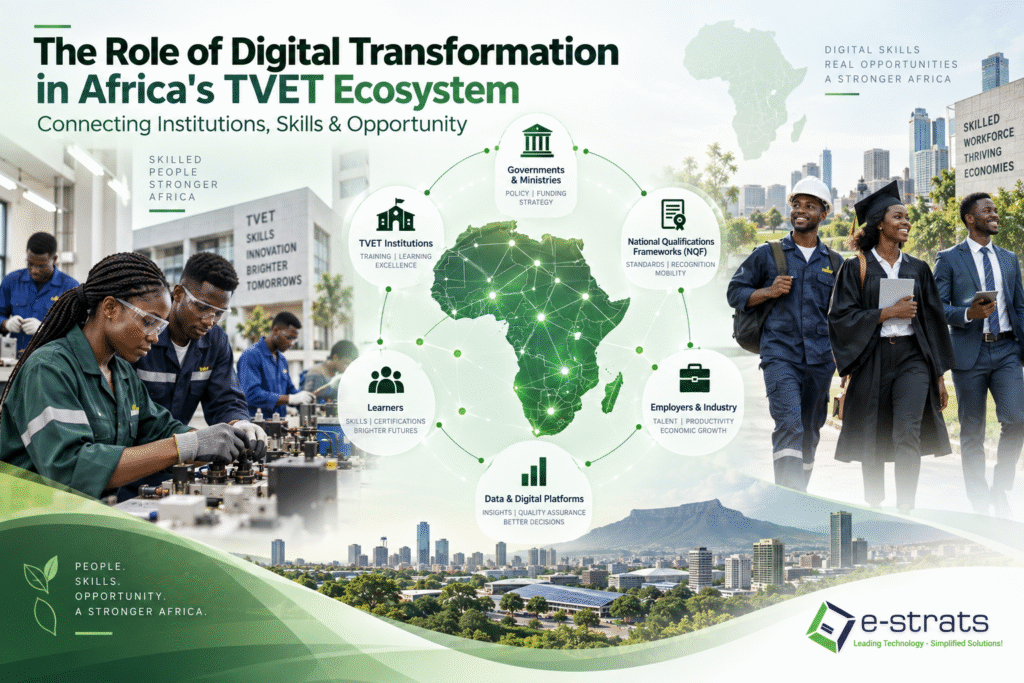
Across Africa, governments and development partners are working to strengthen vocational education, qualification systems and workforce development.
Integrated digital platforms can support these objectives by connecting TVET institutions, qualification authorities, learners, employers and policymakers.
A connected digital ecosystem can bring together:
TVET Management → Qualifications → Accreditation → Learner Records → Assessment → Certification → Digital Credentials → Monitoring and Evaluation → Skills Intelligence
This approach is particularly relevant when projects involve multiple institutions or seek to strengthen national TVET and National Qualifications Framework (NQF) systems.
For African governments and TVET authorities, the opportunity is to develop digital infrastructure that supports both immediate project requirements and long-term national skills development priorities.
European governments and development partners supporting international TVET programmes can also benefit from connected systems that improve project coordination, reporting and institutional sustainability.
Why Choose e-strats as Your TVET Technology Partner?
Achieving sustainable digital transformation requires more than implementing individual software applications. It requires a technology partner that understands how TVET institutions, qualification authorities and workforce development programmes operate.
e-strats supports TVET and NQF digital transformation through solutions that connect institutional processes, qualification management and workforce data.
Its capabilities include:
- TVET and NQF digital transformation
- Qualification and accreditation management
- Institute registration
- Digital qualification registries
- Online credential verification
- Monitoring and evaluation
- Tracer studies and testing services
- Dashboards and data analytics
- System integration and capacity building
Through these capabilities, e-strats helps organisations move toward connected, data-driven and scalable digital skills ecosystems.
For governments and development partners, this provides an opportunity to align technology investments with institutional priorities, project objectives and long-term sustainability.
Build a Connected Digital TVET Ecosystem
If your organisation is planning a TVET investment project, modernising a qualification authority or implementing a national digital transformation programme, integrated digital infrastructure should be considered from the beginning.
The right technology strategy can help connect project activities, improve institutional efficiency, strengthen monitoring and evaluation, and support sustainable workforce development.
e-strats works with governments, TVET authorities and development partners to design and implement digital solutions aligned with their TVET and NQF transformation objectives.
Explore e-strats’ TVET and NQF digital transformation solutions to discuss how an integrated digital platform can support your next skills development investment.
Conclusion
The ROI of TVET Investment Projects depends on the ability to translate financial and institutional investments into meaningful, measurable and sustainable outcomes.
Integrated digital platforms can help achieve this by connecting data, streamlining processes, strengthening monitoring and evaluation, and improving decision-making.
For governments, TVET authorities and donors, the priority should be to look beyond individual software deployments and invest in connected digital ecosystems that support the entire skills development lifecycle.
By combining digital infrastructure, institutional capacity, reliable data and sustainable governance, TVET investment projects can establish a stronger foundation for long-term workforce development.
The goal is not simply to deliver more training. It is to build a TVET system that can demonstrate, sustain and continuously improve the value of its investment.
