
The Rise of the AI Workforce
What Are AI Agents?
For decades, enterprise software has primarily been designed to help people perform their jobs. Employees entered information into systems, reviewed reports, followed workflows, communicated with customers and made decisions based on available information.
AI agents are beginning to change that model. Instead of simply providing information, an AI agent can interpret a goal, access business systems, make decisions within defined boundaries and execute actions. This shift toward agentic AI allows organizations to move from software that supports employees to digital workers that participate directly in business processes.
This is why the AI workforce is becoming increasingly relevant. As enterprise AI evolves, organizations are exploring how AI agents can support sales, customer service, finance, operations, IT and other functions.
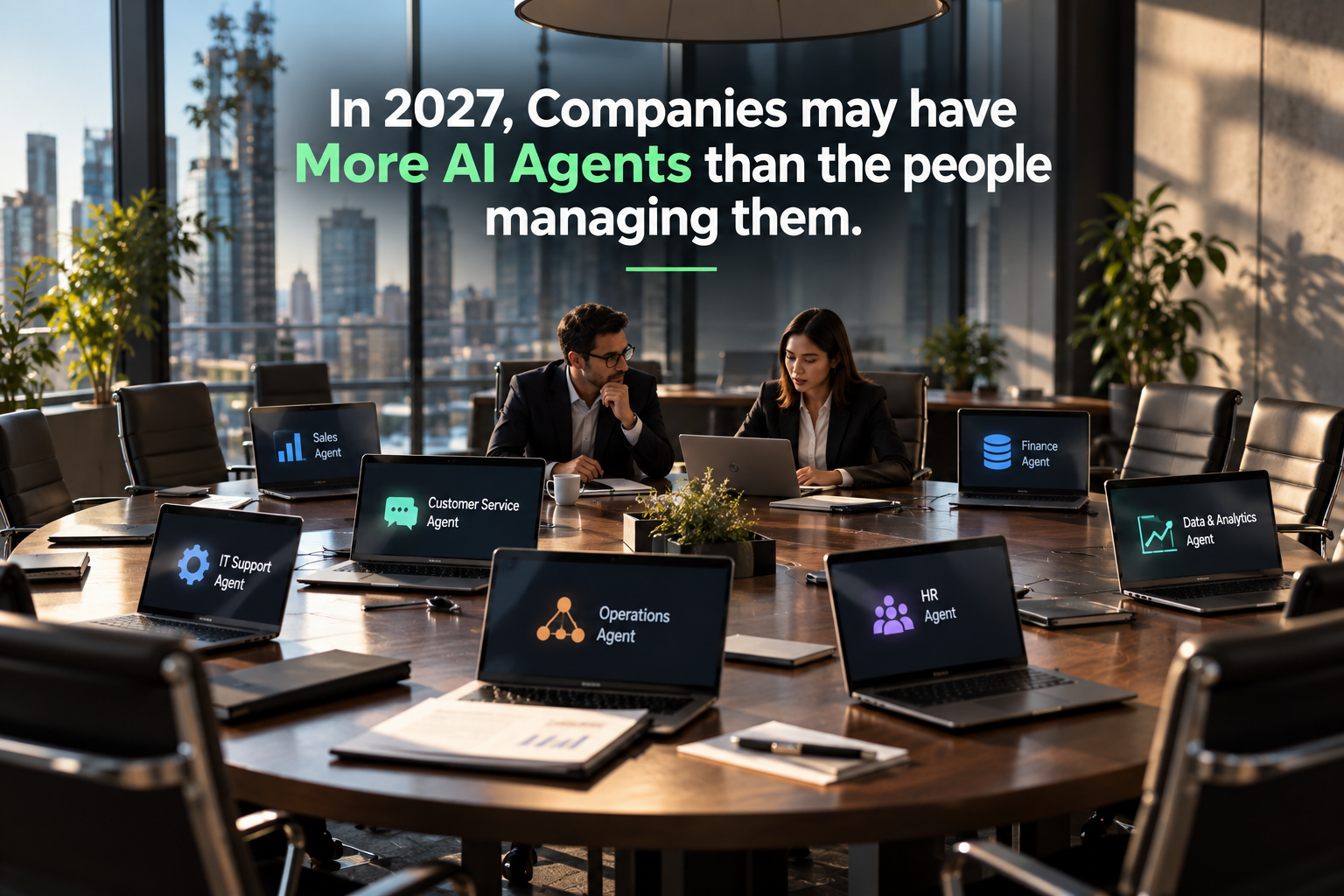
By 2027, some organizations could operate hundreds or even thousands of AI agents in the enterprise. This does not necessarily mean replacing employees. Instead, one employee may supervise or collaborate with multiple specialized agents, creating a new model of human-AI collaboration.
Deloitte’s 2026 research highlights the pace of this transition. Its survey of 3,235 business and technology leaders across 24 countries found that 74% expected at least moderate AI-agent use by 2027, while only 21% reported mature governance for agentic AI.
This gap between AI adoption and organizational readiness could become a defining technology challenge. Companies will need more than AI tools. They will need a clear AI strategy, secure AI integration, reliable enterprise data, modern architecture and effective AI agent governance to turn AI adoption into measurable business value.
An AI agent is more than a chatbot or traditional AI assistant.
A conventional AI system may answer a question, generate content or analyze information. An AI agent can go further by using tools, interacting with applications and executing actions toward a defined objective.
For example, an employee might currently spend several hours identifying new sales leads, checking company information, updating a CRM, preparing an email and scheduling follow-ups.
An AI agent could potentially coordinate much of this workflow. It could identify potential prospects, retrieve relevant information, update the CRM, prepare personalized outreach and initiate the next approved action.
The human employee does not necessarily disappear from the process. Instead, the employee may move from performing every individual task to supervising the workflow and making higher-value decisions.
That distinction is important when discussing the future of enterprise AI.
From AI Assistant to AI Workforce
The evolution of enterprise AI can be viewed as a progression.
| Stage | Primary Role of AI | Typical Business Use | Human Involvement |
|---|---|---|---|
| Traditional AI | Analyze information | Forecasting, reporting, classification | High |
| AI Assistant | Help employees | Writing, research, summarization | High |
| AI Agent | Execute defined tasks | CRM updates, support workflows, document processing | Moderate |
| Multi-Agent System | Coordinate multiple tasks | End-to-end business processes | Moderate to low |
| Agentic Enterprise | Operate across business workflows | Cross-functional autonomous processes | Human oversight and governance |
The important transition is from AI that responds to AI that acts.
As agents become more capable, organizations will increasingly need to think about them as part of their operating model rather than simply another software feature.
Could Companies Really Have More AI Agents Than Employees?
The idea sounds extreme, but the underlying trend is becoming increasingly credible. Gartner predicts that by 2028, the average Fortune 500 enterprise could have more than 150,000 AI agents in use, compared with fewer than 15 in 2025. Gartner describes this as a potential source of significant agent sprawl, IT complexity and management challenges. That prediction should not be interpreted as meaning every company will suddenly employ 150,000 autonomous digital workers.
An enterprise could have thousands of small, specialized agents performing narrow tasks. One agent might monitor inventory, while another validates invoices or prepares financial reports. Elsewhere, specialized agents could monitor cybersecurity events or coordinate customer-service workflows.
The important change is that the cost of creating and deploying digital workers may become dramatically lower than creating equivalent human capacity. That creates an entirely new management challenge. The question becomes less about how many employees an organization has and more about how many human and digital workers it can effectively coordinate.
What Will the AI-Powered Workforce Look Like?
The future AI workforce is unlikely to consist of one giant AI system controlling the entire organization.
Instead, companies are more likely to operate networks of specialized agents connected to business applications, data and workflows.
A sales organization could have prospecting agents, research agents, CRM agents and follow-up agents. Customer service could use agents for ticket classification, knowledge retrieval, response preparation and escalation. Finance could deploy agents for invoice processing, reconciliation and financial analysis.
Software engineering may become another major area of adoption. Development agents can assist with code generation, testing, debugging, documentation and software maintenance.
This creates a model in which an employee might work alongside several specialized agents rather than interacting with one general-purpose AI.
Deloitte’s latest research reinforces this direction: 74% of surveyed leaders expect nearly half of their business processes to be redesigned or rebuilt around AI agents within four years, while 61% expect most agents to operate with substantial autonomy but human oversight.
The implication is significant: AI adoption is increasingly becoming a workflow-design problem, not just a software-selection problem.
AI Agents Will Change Business Processes, Not Just Individual Tasks
One of the biggest mistakes organizations can make is simply adding AI to existing workflows without redesigning the workflow itself.
If a company’s procurement process requires employees to move information between five disconnected systems, adding an AI agent on top may automate individual steps without fixing the underlying architecture.
The stronger approach is to examine the entire process.
For example, instead of asking an AI agent to summarize customer information, an organization could redesign the customer-management workflow so that the agent can retrieve information from the CRM, support platform, billing system and knowledge base, determine what requires attention and prepare the appropriate next action.
That is a much bigger transformation.
It requires enterprise software integration, data accessibility, workflow redesign and appropriate authorization.
Deloitte’s research suggests that organizations are beginning to recognize this distinction. Nearly two-thirds of surveyed executives reported reevaluating business models because agentic AI requires changes to processes and workflows as well as technology deployment.
The Technology Foundation Behind Enterprise AI Agents
An AI agent is only as effective as the environment in which it operates.
An organization may have access to advanced AI models, but if its data is fragmented, APIs are unavailable, legacy applications cannot communicate with modern systems and permissions are poorly defined, agents will struggle to produce reliable business outcomes.
This is where AI integration and enterprise architecture become critical.
A mature AI environment typically needs a connected layer between people, agents, models, business applications, APIs, databases and organizational controls.
The architecture may look conceptually like this:
Employees → AI Agent Interface → Agent Orchestration → Identity & Governance → AI Models → APIs & Integrations → ERP / CRM / Applications → Enterprise Data
This is why enterprise AI should not be treated as a standalone technology project.
It is increasingly becoming part of the organization’s broader digital transformation and technology architecture.
Data Will Become Even More Important
AI agents need access to accurate information to make useful decisions.
If customer data exists in one system, financial information in another, product information in spreadsheets and operational information in legacy databases, an agent may not have a complete view of the situation. Poor data can therefore produce poor decisions at machine speed. This makes data architecture, database modernization, integration and governance increasingly important.
Organizations preparing for an AI-powered workforce should therefore look beyond the AI model itself. The quality, accessibility, security and governance of enterprise data may determine whether AI agents create value or simply automate existing problems. This is closely connected to the broader challenge of becoming an AI-ready organization.
Every AI Agent Needs an Identity
As AI agents become capable of taking actions inside business systems, organizations will need to know exactly which agent performed which action and under whose authority.
An employee logging into an ERP system has an identity, role and permissions. Enterprise AI agents will require similar controls.
An agent responsible for preparing sales reports should not automatically have permission to modify payroll information.
An agent processing customer requests may need access to customer records but not unrestricted access to financial systems.
This makes identity, authentication, authorization and auditability central components of AI agent governance.
NIST launched its AI Agent Standards Initiative in 2026 specifically to support secure and interoperable AI agents, including research around agent security, identity and authorization.
The future enterprise therefore needs to think about AI agents not simply as software objects, but as authorized digital actors operating within business environments.
AI Security Will Become More Complex
Traditional cybersecurity focuses heavily on protecting applications, users, networks and data. AI agents introduce another dimension. An agent may have permission to read information, call APIs, send messages, modify records or initiate workflows. If that agent is compromised or behaves incorrectly, the impact could extend across multiple enterprise systems. The challenge therefore moves from simply asking whether AI is secure to asking whether the entire agent workflow is secure.
Organizations will need to understand what an agent can access, which actions it can perform, what information it can retrieve and when a human must approve an action. This becomes particularly important when agents interact with sensitive customer, financial, employee or operational information.
The Risk of AI Agent Sprawl
The rapid creation of AI agents could create a problem similar to the application and SaaS sprawl organizations already experience. An organization might begin with five useful agents and eventually end up with hundreds created by different teams, departments and software platforms.
Some may overlap. Others may have excessive permissions. Some may no longer have an owner. This is AI agent sprawl.
Gartner’s research highlights the scale of the potential problem, predicting more than 150,000 agents in use at an average Fortune 500 enterprise by 2028 and noting that only 13% of organizations believe they currently have the right governance in place. The solution is not necessarily to prevent employees from creating agents. Instead, organizations need centralized visibility, clear ownership, appropriate controls and a reliable inventory of the agents operating across the enterprise.
Humans Will Still Matter
The rise of an AI workforce does not automatically mean the disappearance of the human workforce. In many cases, the highest-value model will be human + AI collaboration. Humans can provide judgment, accountability, strategic thinking, relationship management and ethical decision-making, while AI agents handle large volumes of repetitive analysis and execution.
Deloitte’s 2026 research found that 75% of surveyed leaders believe collaboration between humans and AI agents creates more value than agent-powered automation alone. This suggests that the future organization may not be divided into “human jobs” and “AI jobs.” Instead, jobs themselves may be redesigned around human-agent teams.
A manager may supervise people and agents. A software architect may design systems where developers collaborate with coding agents. A sales executive may focus on relationships while agents handle research and administrative workflows. The competitive advantage will come from designing these teams effectively.
What Organizations Should Do Now?
The AI-Ready Organization of 2027
Companies do not need to wait until 2027 to prepare. The most effective starting point is to understand where AI agents can create measurable business value and whether the existing technology environment is capable of supporting them. Organizations should begin with business processes rather than AI tools. Identify repetitive, data-intensive and rules-driven workflows where AI can create measurable improvements. Then assess the underlying applications, data sources, APIs, security controls and integration requirements. From there, organizations can define the appropriate level of autonomy.
Some agents may simply recommend actions. Others may execute actions automatically within strict boundaries. High-impact decisions may always require human approval. Maximum autonomy should not be the objective. Instead, organizations should pursue appropriate autonomy with measurable business value and controlled risk.
An AI-ready organization will not simply have access to the latest AI models. It will have the technology foundation, governance and operating model required to use AI agents responsibly at scale.
| AI-Ready Capability | What It Means for the Business |
|---|---|
| AI Strategy | AI initiatives are connected to measurable business priorities rather than experimentation alone. |
| Data Foundation | Business data is accessible, reliable, governed and suitable for AI-driven workflows. |
| Modern Architecture | Applications and infrastructure can support AI workloads and future integrations. |
| Enterprise Integration | Agents can securely interact with ERP, CRM, databases, APIs and business applications. |
| AI Governance | Organizations define agent ownership, autonomy, permissions, monitoring and accountability. |
| AI Security | Identity, authorization, data protection and agent activity are controlled and monitored. |
| Workflow Redesign | Business processes are redesigned around human-agent collaboration rather than simply adding AI to old processes. |
| Measurement | Organizations measure productivity, cost, quality, adoption, risk and business outcomes. |
| Scalable Implementation | Successful AI use cases can move from pilot to production and expand across the organization. |
This is the difference between experimenting with AI and building an AI-powered enterprise.
The Competitive Advantage Will Not Be the AI Model
AI models are becoming increasingly accessible. The bigger differentiator will be how effectively a company connects AI to its own business. Two organizations may use similar AI models but achieve completely different results because one has better data, cleaner processes, stronger integrations and clearer governance. This means the competitive advantage will increasingly come from the technology layer surrounding AI.
Organizations that can connect agents to their enterprise data, applications and workflows will be better positioned to turn AI capabilities into measurable business outcomes. The winners may not simply be the organizations with the most AI agents. They may be the organizations that manage the relationship between humans, AI agents, data and business systems most effectively.
Where IT Consulting Becomes Important?
This is also where strategic IT consulting becomes increasingly valuable. Implementing an AI agent is relatively straightforward compared with redesigning the enterprise environment around hundreds or thousands of agents.
Organizations need to understand their current architecture, identify integration gaps, modernize legacy systems where necessary, establish governance and prioritize AI opportunities based on business value. This is why AI strategy should increasingly be connected to digital transformation, enterprise architecture, systems integration and custom software development rather than treated as an isolated AI initiative.
e-strats works across these areas, including AI and data strategy, IT consulting and systems integration, digital transformation advisory, AI automation, enterprise software integration and custom technology solutions. Organizations exploring an AI-powered workforce can start with an assessment of their current technology environment, identify high-value AI opportunities and develop a practical roadmap from experimentation to production.
The 2027 AI Workforce Is Really a Technology Transformation
The idea of companies having more AI agents than employees may sound futuristic, but the direction is already becoming visible. Enterprise AI agents are moving from simple assistants toward systems capable of executing real business processes. At the same time, organizations are discovering that deploying agents at scale creates new requirements around data, architecture, integration, identity, security and governance. Organizations that prepare early can gain an advantage—not by deploying the greatest number of agents, but by building an environment where AI agents can operate safely, efficiently and in coordination with human teams.
The question for business leaders is no longer whether AI agents are coming.
It is whether their organization will be ready to manage them when they arrive.
