
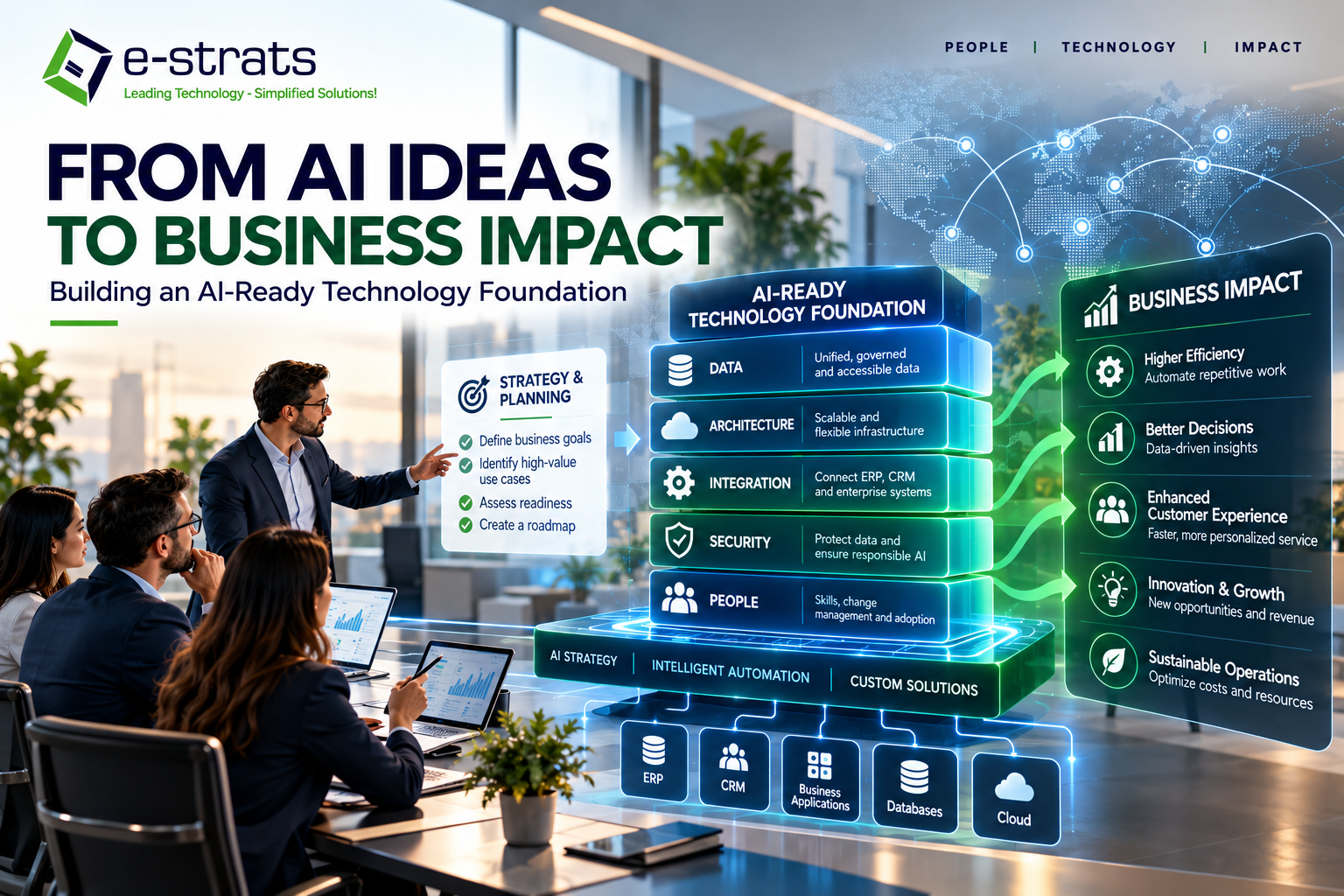
Artificial intelligence is no longer simply an innovation project sitting inside an IT department.
For business leaders, AI is becoming part of the technology foundation through which organizations operate, make decisions, serve customers and automate work.
But there is a major difference between using AI tools and building an organization that is actually ready to integrate AI into its business.
An employee using an AI assistant to summarize documents is useful.
An enterprise connecting AI to its CRM, ERP, operational databases, customer workflows, analytics and decision-making processes is a very different level of transformation.
That is where AI strategy consulting becomes important.
Organizations across the United States, United Kingdom, Europe, the Middle East and Türkiye are approaching AI from different regulatory, operational and industry perspectives. Yet the underlying technology challenge is remarkably similar:
How do you build an AI foundation that works with the systems, data, people and business processes you already have?
The answer is not simply buying another AI platform.
It starts with strategy, data, architecture, security, integration and measurable business outcomes.
Why AI Strategy Matters More Than Simply Adopting AI Tools?
The UK’s Office for National Statistics reported in July 2026 that self-reported AI use among UK businesses with 10 or more employees had increased from around 12% to around 35% since late 2023. However, the average number of AI technologies used by adopting businesses increased only modestly, suggesting that adoption does not necessarily mean deep or broad integration.This distinction matters.
An organization can have:
- ChatGPT or another generative AI tool
- AI-powered productivity software
- A chatbot
- An AI analytics experiment
- Several disconnected AI pilots
and still lack an enterprise AI strategy.
The real question is:
Can AI become part of the organization’s operating model?
That requires a technology foundation capable of supporting AI securely, reliably and at scale.
What Is an AI-Ready Organization?
An AI-ready organization is not necessarily one that has the most AI tools.
It is an organization that has the strategy, data, technology architecture, governance, people and processes required to deploy AI effectively.
A practical model looks like this:
Strategy → Data → Architecture → Security → People → Implementation → Measurement → Scale
Each layer supports the next.
If the strategy is unclear, technology investments become fragmented.
If data is unreliable, AI outputs become unreliable.
If architecture is disconnected, AI cannot access the information and systems it needs.
If security and governance are missing, scaling becomes risky.
If employees are not prepared, adoption remains shallow.
If business outcomes are not measured, leadership cannot determine whether AI investment is creating value.
This is why AI strategy consulting should begin before selecting an AI model or technology platform.
1. Start With Business Strategy, Not AI Technology
One of the most common mistakes organizations make is starting with technology.
A leadership team discovers a new AI capability and immediately asks:
“How can we implement this?”
A better question is:
“What business problem are we trying to solve?”
AI strategy should begin by identifying measurable business priorities.
For example:
| Business Challenge | Potential AI Opportunity |
|---|---|
| High customer-support workload | AI customer service automation |
| Slow sales qualification | AI lead qualification |
| Large volumes of documents | Intelligent document processing |
| Difficult forecasting | Predictive analytics |
| Manual reporting | AI-powered reporting |
| Complex field operations | AI scheduling and optimization |
| Repetitive back-office processes | Intelligent automation |
| Slow access to organizational knowledge | Enterprise AI assistant |
This approach prevents organizations from implementing AI simply because it is fashionable.
Instead, AI becomes a business capability connected to measurable objectives.
2. Build an AI Data Strategy
AI is only as useful as the information surrounding it.
That makes AI data strategy one of the most important parts of AI readiness.
Many enterprises have valuable information distributed across:
- ERP systems
- CRM platforms
- HR systems
- Finance applications
- Databases
- Data warehouses
- Cloud platforms
- Documents
- Operational applications
- Third-party platforms
The problem is not necessarily a lack of data.
The problem is that the data may be:
- fragmented
- duplicated
- inconsistent
- outdated
- difficult to access
- poorly governed
- stored in incompatible systems
IBM’s 2026 research highlights data quality and data silos as important obstacles to organizations trying to understand and realize AI value.
3. Modernize the Technology Architecture for AI
AI cannot operate effectively in isolation from the rest of the enterprise.
Consider a business with:
ERP + CRM + HR + Finance + Operations + Customer Portal + Data Warehouse
If each system operates independently, AI has limited visibility.
The goal is not necessarily to replace every existing system.
Instead, organizations can create an AI integration architecture that allows intelligent capabilities to interact with existing applications.
For example:
ERP → Integration Layer → AI Services
CRM → Integration Layer → AI Services
Business Data → Integration Layer → AI Services
The AI layer can then support:
- predictive analytics
- intelligent automation
- recommendation engines
- conversational interfaces
- document processing
- forecasting
- workflow orchestration
- decision support
This is where enterprise systems integration becomes a strategic AI capability.
IBM’s 2026 technology research similarly emphasizes infrastructure adaptability and integration as important foundations for scaling AI and agentic systems.
4. Don't Ignore Legacy Systems
One of the biggest barriers to AI implementation is often not AI itself.
It is the technology environment surrounding it.
Many established organizations still depend on legacy applications that were never designed to support modern APIs, real-time data exchange or AI workloads.
That does not automatically mean those systems need to be replaced.
There are several possible approaches:
Modernize
Upgrade the existing platform.
Integrate
Connect the legacy application with modern systems through APIs or integration layers.
Rebuild
Replace critical components with modern applications.
Wrap
Create an abstraction layer around the legacy system while gradually modernizing the underlying architecture.
Retire
Remove systems that no longer provide sufficient business value.
The right choice depends on business criticality, technical debt, cost, security, integration requirements and future strategy.
This is why legacy systems modernization should be part of an organization’s broader AI technology strategy.
5. Make AI Security Part of the Architecture
Enterprise AI introduces new questions around:
- data access
- identity
- permissions
- privacy
- model security
- intellectual property
- third-party AI providers
- prompt injection
- auditability
- monitoring
- human oversight
Security should therefore not be added after an AI system has already been deployed.
It should be designed into the architecture.
The NIST AI Risk Management Framework provides a voluntary framework for organizations developing, deploying or using AI systems, with emphasis on managing AI risks and supporting trustworthy AI. Its core functions are Govern, Map, Measure and Manage.
For international businesses, AI governance also needs to reflect the regulatory and data-protection requirements applicable to their markets and industries.
For example, organizations operating in the UK, EU, US, Gulf markets or Türkiye may face different regulatory, contractual and data-residency considerations.
An effective AI governance framework should therefore address:
- permitted AI use cases
- sensitive data
- access controls
- vendor requirements
- human oversight
- model evaluation
- monitoring
- audit trails
- incident management
- data retention
- compliance requirements
6. Prepare People for AI Adoption
Technology does not transform organizations by itself.
People do.
An AI implementation can fail even when the technology works perfectly if employees:
- don’t understand the system
- don’t trust the outputs
- don’t know when to use it
- fear the change
- don’t understand their new responsibilities
- continue using old manual processes
This makes AI change management an essential part of AI transformation.
Organizations should consider:
Training + communication + workflow redesign + leadership alignment + measurement
The goal should not simply be teaching employees how to use an AI tool.
It should be helping teams understand:
How does AI change the way we work?
7. Connect AI to Business Processes
AI creates greater value when it becomes part of a workflow.
Consider a conventional process:
Customer submits inquiry → Employee reviews inquiry → Employee checks CRM → Employee researches information → Employee responds
An AI-enabled workflow could become:
Customer submits inquiry → AI understands request → AI retrieves approved information → AI checks CRM → AI prepares response → Human approves or AI completes permitted action
The difference is important.
The organization isn’t merely adding an AI chatbot.
It is redesigning the process around intelligent automation.
This is where business process automation, AI integration and custom software development can work together.
8. Choose the Right AI Use Cases
Not every process needs AI.
A strong AI strategy prioritizes use cases according to business value and feasibility.
A practical scoring framework can evaluate:
| Criteria | Key Question |
|---|---|
| Business impact | How much value could this create? |
| Frequency | How often does the process occur? |
| Data availability | Do we have the necessary data? |
| Integration | Can it connect to existing systems? |
| Risk | What happens if the AI is wrong? |
| Adoption | Will employees or customers use it? |
| Cost | What will implementation and operation cost? |
| Measurement | Can we measure the outcome? |
| Scalability | Can the solution expand across the organization? |
This produces a portfolio of AI opportunities instead of a collection of disconnected experiments.
9. Move From AI Pilot to Production
A successful AI proof of concept is not the same as a successful enterprise implementation.
A pilot might work with:
- limited users
- clean data
- controlled inputs
- manual oversight
- temporary infrastructure
Production requires much more.
Organizations need:
- scalable architecture
- reliable integrations
- security controls
- data pipelines
- monitoring
- logging
- model evaluation
- performance management
- cost controls
- user management
- support processes
- governance
IBM’s 2026 research argues that organizations need to rethink architecture, governance and investment discipline as AI moves toward larger-scale deployment.
The objective should therefore be:
Pilot → Validate → Integrate → Operationalize → Measure → Scale
10. Build an AI ROI Framework
One of the biggest questions business leaders ask is simple:
What will we get back from our AI investment?
That question should be answered before a major AI program is scaled.
AI ROI can include:
Cost reduction
Reducing repetitive manual work.
Productivity
Helping employees complete tasks faster.
Revenue
Improving sales conversion, customer engagement or product opportunities.
Customer experience
Improving response times and personalization.
Risk reduction
Detecting anomalies, improving controls and reducing errors.
Decision quality
Giving leaders better access to information and predictive insights.
IBM reported in February 2026 that 90% of technology leaders surveyed were struggling to measure ROI on technology investments, with data quality, data silos and governance among the issues affecting AI value measurement.
That is why AI measurement should be designed into the project from the beginning.
The AI-Ready Technology Foundation
A practical enterprise AI foundation can be visualized as eight connected layers:
1. Strategy
Define business priorities and high-value AI use cases.
2. Data
Establish reliable, accessible and governed data.
3. Architecture
Create an environment capable of integrating AI with existing systems.
4. Security
Protect data, applications, users and AI workflows.
5. People
Develop internal capabilities and prepare employees.
6. Implementation
Move selected use cases from pilot to production.
7. Measurement
Track business outcomes, adoption, performance and ROI.
8. Scale
Expand successful AI capabilities across the organization.
The important point is that these are connected layers, not separate projects.
Where AI Consulting Creates Business Value
A technology partner should do more than recommend AI tools.
Effective AI consulting services should connect business strategy with technical execution.
That can include:
AI Readiness Assessment
Evaluate existing technology, data, processes and capabilities.
AI Strategy
Identify business opportunities and establish priorities.
Technology Architecture
Design the architecture required for scalable AI implementation.
Data Strategy
Assess data quality, accessibility, governance and integration.
AI Integration
Connect AI capabilities with ERP, CRM, databases and business applications.
Automation
Identify processes suitable for intelligent automation.
Custom AI Solutions
Develop AI applications around specific business requirements.
AI Governance
Create appropriate controls for security, privacy, risk and responsible use.
Implementation
Move validated AI use cases from concept to production.
Continuous Optimization
Measure performance and improve systems as business requirements evolve.
How e-strats Consulting Helps Organizations Move From AI Ideas to Implementation?
At e-strats, we approach AI as part of a broader business and technology transformation, rather than as an isolated software purchase.
Our consulting practice covers AI & Data Strategy, IT Consulting & System Integration, and Digital Transformation Advisory, helping organizations move from strategy and assessment through implementation and capacity building.
Our technical capabilities include:
- AI-powered applications
- intelligent automation
- enterprise AI integration
- predictive analytics
- AI chatbots
- CRM and ERP integration
- database architecture
- cloud solutions
- custom software development
- digital transformation
- legacy systems modernization
Explore e-strats AI & Automation Solutions
Explore e-strats IT Consulting & Digital Transformation
Explore e-strats Custom Technology Services
The objective is straightforward:
Understand the business → assess the technology → identify opportunities → design the architecture → implement the solution → measure the outcome → scale what works.
This approach can support organizations looking for a technology development partner, implementation partner, strategic IT consultant, or international software engineering collaboration.
A Practical AI Readiness Checklist for Business Leaders
Before starting a major AI initiative, leadership teams should be able to answer these questions:
Strategy
- What business problem are we solving?
- Which AI use cases have the greatest potential impact?
Data
- Is the required data available?
- Is it accurate, secure and governed?
Technology
- Can our existing systems integrate with AI?
- Where do we have legacy technology constraints?
Security
- What information will AI access?
- What controls are required?
People
- Who will own the AI initiative?
- What skills and training are required?
Implementation
- Can we move the selected use case into production?
- How will the solution be monitored?
Measurement
- What KPIs define success?
- How will we calculate AI ROI?
Scale
- If the pilot works, can the architecture support 10x or 100x the usage?
If several answers are unclear, the organization may need an AI readiness assessment before committing to large-scale implementation.
The Future of AI Is Not Just About Better Models
AI models will continue to evolve.
New models will arrive. New AI agents will emerge. New automation capabilities will become available.
But organizations cannot rebuild their entire technology environment every time AI technology changes.
That is why the strategic advantage increasingly comes from building an adaptable technology foundation.
A modern AI architecture should allow organizations to:
- adopt new AI capabilities
- connect different models
- integrate business systems
- protect sensitive information
- control access
- measure performance
- manage costs
- replace technologies when necessary
- scale successful use cases
In other words:
The goal is not to build technology for today’s AI. It is to build an organization capable of adapting to tomorrow’s AI.
From AI Ideas to Business Impact
AI adoption does not begin with choosing a model.
It begins with understanding the business.
The strongest AI programs connect:
Business Strategy + Data + Architecture + Security + People + AI + Software + Measurement
When those elements work together, AI can move beyond experimentation and become part of the organization’s operating model.
For organizations in the USA, UK, Middle East, Türkiye and other international markets, this creates an opportunity to approach AI as a long-term technology and business transformation rather than a short-term technology trend.
If your organization is exploring AI strategy, enterprise AI integration, intelligent automation, custom AI software or digital transformation, e-strats can work with your leadership and technology teams to assess the opportunity, define the roadmap and develop the systems required to turn AI ideas into measurable business outcomes.
Looking to identify where AI could create measurable value in your organization?
Talk to e-strats about your AI Strategy & Technology Roadmap
