
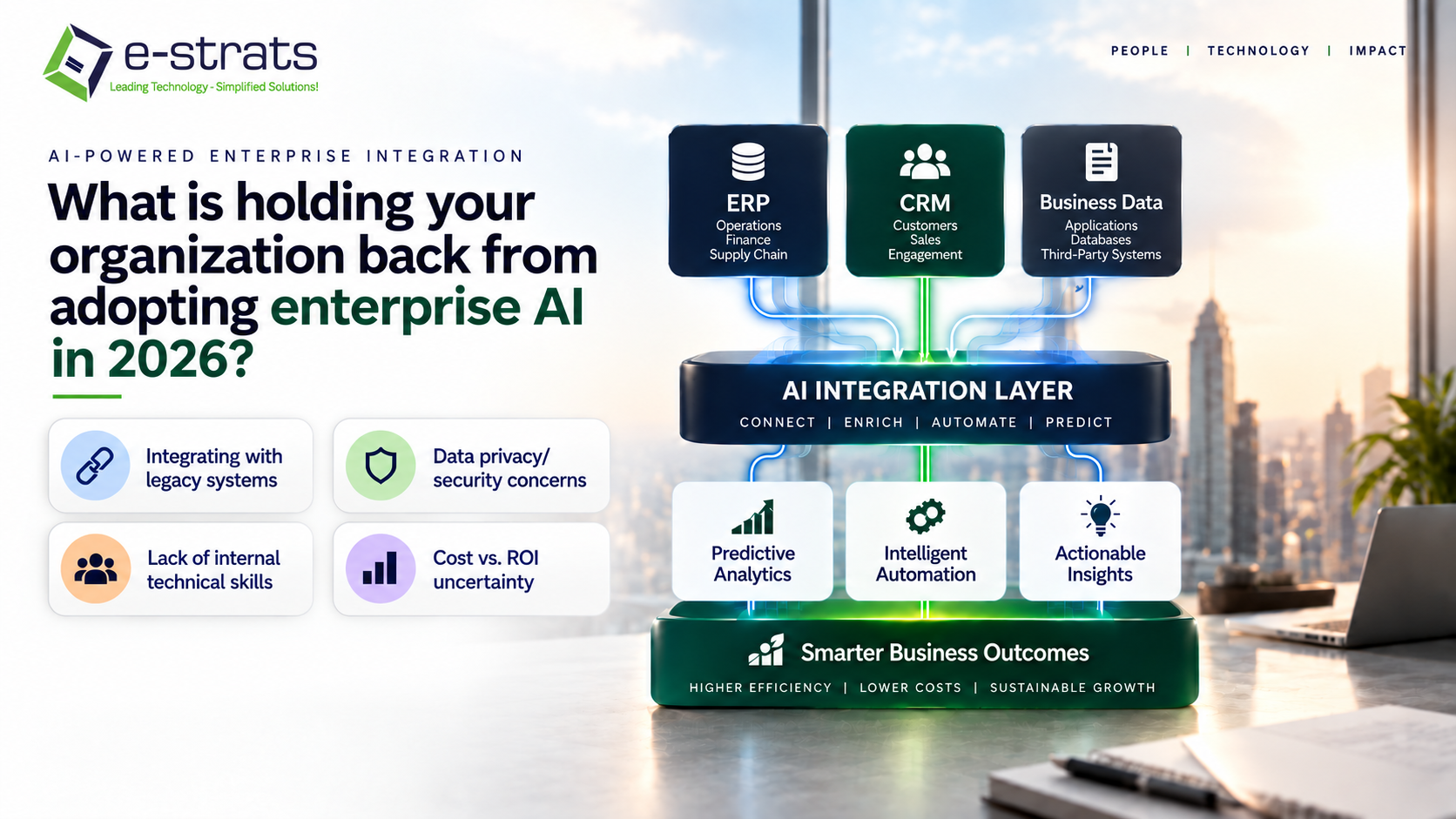
Enterprise AI adoption is moving from experimentation to a strategic business priority. Organizations are exploring AI for customer service, automation, analytics, forecasting, knowledge management, software development, and operational decision-making.
Yet many organizations still struggle to move from AI pilots to production-ready, scalable enterprise AI.
The question is no longer simply:
“Can AI create value for our business?”
For many organizations, the harder question is:
“What is preventing us from adopting AI at scale?”
The barriers are often less about the AI models themselves and more about the foundations around them: data, legacy systems, security, skills, integration, business strategy, change management, and uncertainty about ROI.
Recent research reflects this. McKinsey’s 2026 research identifies regulatory/legal concerns, concerns about AI itself, organizational challenges, inadequate technology infrastructure, unclear strategy, and financial constraints among barriers to AI adoption at scale. (McKinsey & Company) IBM research has similarly identified limited AI skills, data complexity, integration and scaling difficulties, ethical concerns, and cost among important barriers. (IBM Newsroom)
So, what is holding organizations back from enterprise AI adoption?
Let’s look at the biggest barriers—and what organizations can do about them.
1. No Clear Enterprise AI Strategy
One of the biggest AI adoption barriers is starting with the technology instead of the business problem.
Organizations may ask:
- Which AI model should we use?
- Should we build a chatbot?
- Should we deploy AI agents?
- Should we use generative AI?
- Should we move to an AI platform?
But these questions come too early.
Before selecting a technology, organizations should determine:
- Which business problems should AI solve?
- Where is the greatest operational friction?
- Which processes are suitable for automation?
- Where could AI improve decision-making?
- Which customer experiences could benefit from AI?
- What measurable business outcome is expected?
For example, “implement generative AI” is not a business objective.
A stronger objective might be:
Reduce customer-support response time by automating repetitive inquiries while keeping human agents available for complex cases.
That objective provides a basis for evaluating technology.
The lesson
Enterprise AI adoption should begin with business outcomes, not AI tools.
A practical AI strategy connects business priorities, use cases, data, technology architecture, governance, people, and measurable outcomes.
2. Legacy Systems Make AI Integration Difficult
AI doesn’t operate in isolation.
For enterprise AI to create meaningful value, it often needs access to information stored inside existing systems such as:
- ERP
- CRM
- HR platforms
- Finance systems
- Supply-chain applications
- Document repositories
- Databases
- Customer portals
- Operational applications
This creates one of the most important challenges in enterprise AI implementation:
How does AI securely access the organization’s existing data and processes?
If critical systems are old, poorly documented, disconnected, or difficult to integrate, AI deployment becomes significantly more complicated.
An organization might have an excellent AI model but still struggle to use it because the model cannot reliably access the right business information.
This is why AI integration needs to be considered part of the technology strategy from the beginning.
Instead of replacing every existing system, organizations can often modernize their architecture through:
- APIs
- Integration layers
- Data platforms
- Cloud services
- Modern application architecture
- Secure identity and access management
- Event-driven integration
The goal is not necessarily to eliminate everything that is old.
The goal is to create an environment where modern AI capabilities can work with the systems the business already depends on.
3. Data Is Not Ready for AI
AI depends on data.
But many organizations have data spread across multiple systems, departments, databases, spreadsheets, documents, and applications.
Common problems include:
- Duplicate records
- Inconsistent data
- Missing information
- Outdated databases
- Data silos
- Poor data ownership
- Inconsistent formats
- Limited data governance
- Difficult data access
This creates a fundamental AI readiness problem.
If an organization cannot confidently answer:
“Where is our data, who owns it, how reliable is it, and who is allowed to access it?”
then scaling AI becomes difficult.
Building an AI-ready data foundation
Organizations should establish:
Data discovery
Understand what data exists and where it resides.
Data quality
Identify inaccurate, incomplete, duplicated, or outdated information.
Data governance
Define ownership, policies, access controls, and accountability.
Data integration
Connect relevant sources through reliable and secure architectures.
Data security
Protect sensitive information throughout its lifecycle.
e-strats provides database architecture, data integration, migration, optimization, and security-focused database services that can support this type of modernization. (e-strats)
4. Data Privacy and Security Concerns
AI introduces another important consideration:
What happens to sensitive organizational data when it is processed by AI?
Organizations may be dealing with:
- Customer information
- Financial records
- Employee information
- Intellectual property
- Business contracts
- Operational data
- Confidential documents
This makes AI security and data privacy central to enterprise AI adoption.
Organizations need to consider:
- Where data is stored
- Where AI processing occurs
- Who can access AI systems
- What information AI applications can retrieve
- How prompts and responses are handled
- How sensitive information is protected
- How AI activity is logged
- How access is revoked
- How third-party AI providers are governed
Security should not be added after the AI system has already been built.
Security should be part of the architecture.
This means designing:
Identity → Access → Data → AI → Monitoring → Governance
as one connected security model.
For organizations operating in regulated industries, these considerations become even more important.
5. Lack of Internal AI Skills
Another significant barrier is the shortage of people who understand both AI technology and business operations.
Enterprise AI may require expertise across:
- AI/ML engineering
- Data engineering
- Software engineering
- Cloud architecture
- Cybersecurity
- APIs and integration
- Data governance
- Business analysis
- Change management
IBM’s research has identified limited AI skills and expertise as a leading barrier among organizations adopting or exploring AI. (IBM Newsroom)
But organizations don’t necessarily need to build a massive AI department before starting.
A practical approach can combine:
Internal business expertise + internal IT capabilities + specialist AI consulting
This allows organizations to develop AI capabilities while gradually building internal knowledge.
e-strats’ consulting practice combines AI & Data Strategy, IT consulting, systems integration, and capacity building, helping organizations move from strategy toward implementation. (e-strats)
6. Uncertainty About AI ROI
One of the biggest questions executives ask is:
“What will we actually get back from this investment?”
This is reasonable.
AI projects can involve costs for:
- Infrastructure
- Cloud services
- AI models
- Data preparation
- Integration
- Development
- Security
- Training
- Monitoring
- Ongoing maintenance
And not every AI use case will generate meaningful business value.
Recent IBM reporting based on a survey of 1,510 technology leaders found that 90% reported difficulty measuring ROI on IT investments, while data quality and data silos were among the factors complicating the business case for AI. (IBM)
A better approach: prioritize use cases by business value.
Before launching an AI initiative, evaluate:
7. AI Pilots Don't Scale
Many organizations successfully demonstrate an AI proof of concept.
The problem comes later.
A chatbot works in a controlled demonstration.
A predictive model works on a limited dataset.
An AI assistant answers test questions.
But moving from prototype to production introduces entirely different requirements.
Production AI may require:
- Enterprise integration
- Security
- Monitoring
- Scalability
- Governance
- Data pipelines
- User management
- Performance management
- Model evaluation
- Cost controls
- Human oversight
This is often where enterprise AI implementation becomes significantly more complex.
A successful proof of concept is not necessarily a successful enterprise solution.
Organizations should therefore ask from the beginning:
“If this works, how will we scale it?”
8. Employees Are Not Prepared for Change
AI adoption is not purely a technology problem.
It is also a people problem.
AI may change:
- Job responsibilities
- Workflows
- Decision-making
- Customer interactions
- Reporting
- Management processes
- Performance expectations
If employees don’t understand why AI is being introduced or how it will affect their work, adoption can slow down.
Effective AI change management should include:
- Employee involvement
- Training
- Clear communication
- Process redesign
- Leadership support
- Feedback mechanisms
- Human oversight
The objective should not simply be:
“Deploy AI.”
It should be:
“Help people work better with AI.”
9. AI Is Added to Processes Instead of Redesigning Them
Another common mistake is adding AI to an inefficient process without changing the process itself.
For example:
An organization has a slow customer-support workflow.
Instead of redesigning the workflow, it adds a chatbot at the front.
The chatbot may answer simple questions, but the underlying processes remain fragmented.
A stronger approach examines the entire workflow:
Customer Request → AI Classification → Knowledge Retrieval → Automation → Human Escalation → Resolution → Feedback
This is where intelligent automation becomes more valuable than simply adding a chatbot.
AI should be integrated into the process—not simply placed on top of it.
e-strats’ AI services include AI-powered customer support, workflow automation, predictive insights, virtual assistants, and AI-driven business process automation. (e-strats)
10. There Is No AI Governance Framework
As organizations increase AI usage, governance becomes increasingly important.
An enterprise AI governance framework can define:
- Approved AI use cases
- Data access policies
- Security requirements
- Model evaluation
- Human oversight
- Responsible AI practices
- Monitoring
- Documentation
- Vendor requirements
- Incident management
Governance should not be designed to prevent innovation.
It should create a safe framework for innovation.
The objective is to allow teams to experiment while establishing clear boundaries around sensitive data, security, risk, and accountability.
What Does an AI-Ready Organization Look Like?
An organization does not need to have every AI capability in place before beginning its AI journey.
Instead, it should progressively build the foundations required for sustainable adoption.
A practical AI readiness model looks like this:
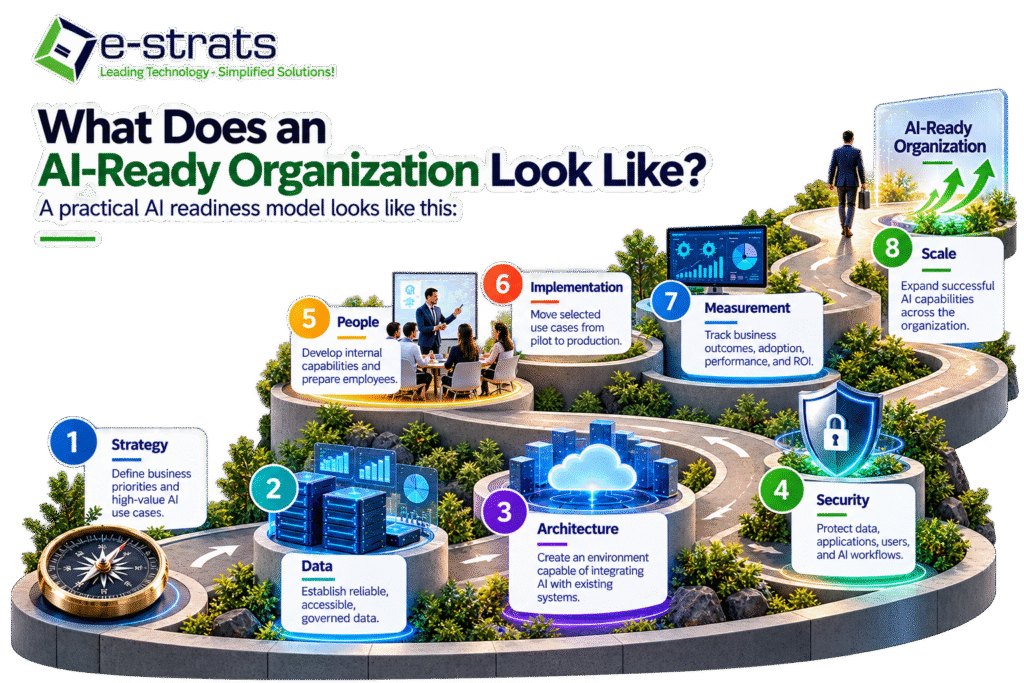
This approach makes enterprise AI adoption a structured transformation journey rather than a collection of disconnected experiments.
How an IT Consulting Partner Can Help in Enterprise AI Adoption?
Organizations often don’t need another AI tool.
They need clarity.
They need to understand:
- Where AI can create value
- Whether their technology environment is ready
- Which systems need modernization
- How data should be integrated
- Which AI use cases should come first
- What security controls are required
- How AI should connect with ERP and CRM systems
- How to measure ROI
- How to move from pilot to production
This is where AI consulting and strategic IT consulting can help.
At e-strats, our consulting services cover AI & Data Strategy, IT Consulting & System Integration, digital transformation advisory, and technology capacity building. The objective is to connect business strategy with practical technology implementation. (e-strats)
For organizations that need implementation support, e-strats also provides AI applications, intelligent automation, chatbots, predictive analytics, and AI integration with existing enterprise systems. (e-strats)
A Practical Enterprise AI Adoption Framework
Before investing heavily in AI, organizations can ask these eight questions:
1. What business problem are we solving?
If the problem isn’t clear, the AI use case probably isn’t ready.
2. Do we have the right data?
AI quality depends heavily on data quality and accessibility.
3. Can our existing systems support AI integration?
Review APIs, architecture, databases, security, and legacy dependencies.
4. What are the security and privacy requirements?
Identify sensitive information and establish appropriate controls.
5. Do we have the required skills?
Determine what can be handled internally and where specialist expertise is required.
6. How will employees use the technology?
Design adoption and change management into the project.
7. How will we measure ROI?
Define measurable outcomes before implementation.
8. How will we scale it?
Design successful pilots with production and enterprise requirements in mind.
If an organization can answer these questions clearly, it has a much stronger foundation for AI adoption at scale.
Enterprise AI Adoption Is More Than Choosing an AI Model
The AI market is moving quickly.
New models, agents, automation platforms, copilots, and AI services appear constantly.
But organizations shouldn’t confuse access to AI technology with AI readiness.
The real competitive advantage comes from building the ability to use AI securely, intelligently, and repeatedly across business operations.
That requires:
Strategy + Data + Architecture + Integration + Security + People + Governance + Measurement
The organizations that address these foundations can move beyond experimentation and build AI capabilities that are connected to real business outcomes.
Is Your Organization Ready for Enterprise AI?
If your organization is exploring AI but isn’t sure where to begin, the first step doesn’t have to be a major implementation.
Start with an assessment.
Evaluate your:
- Technology architecture
- Data environment
- Existing systems
- Integration capabilities
- AI use cases
- Security requirements
- Internal skills
- Business objectives
Then build an AI strategy and implementation roadmap based on business value and organizational readiness.
At e-strats, we help organizations move from AI ideas to practical, integrated, scalable solutions—combining strategic consulting, AI and data expertise, systems integration, intelligent automation, and enterprise software development. (e-strats)
The question isn’t whether your organization can use AI.
The more important question is:
Is your organization ready to use AI in a way that creates measurable business value?
Start with strategy. Build the right foundation. Then scale AI with purpose.
